
Your Cart is Empty


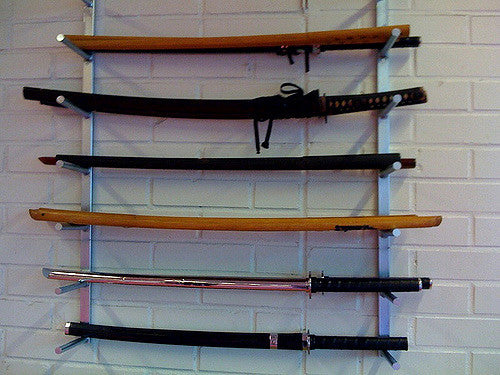

Traditional Japanese swords like the katana are viewed as being the strongest, highest quality swords the world has ever seen. There are several factors attributing to their superior quality, one of which is a swordmaking technique known as tsuchioki. So, what is tsuchioki exactly and how does it affect the quality of a sword?
Tsuchioki: The Basics
Tsuchioki is a swordmaking process pioneered in feudal Japan. In involves coating the blade with multiple layers of wet clay slurry.
If you keep up with our blog, you're probably familiar with the concept of differential hardening. Also pioneered by Japanese swordsmiths during the feudal era, it involves heating and cooling different parts of the blade at different temperatures. Well, tsuchioki specifically refers to the process of coating the blade with clay slurry for the purpose of differential heat treatment.
Tossing some clay onto a sword's blade may sound simple enough, but it's actually a methodical process that will greatly influence the finished sword's properties. If the wrong ingredients are used -- or applied in the wrong manner -- the sword may be weak or brittle.
Without tsuchioki, differential heat treatment wouldn't be possible. The application of wet clay slurry allows different parts of the blade to cool at different temperatures. The edge of the blade, for instance, is typically coated with a thinner layer of wet clay slurry, whereas the spine is coated with a thicker layer. Because the edge contains a thinner layer, it cools quicker than the spine; thus, resulting in a strong edge and soft, flexible spine.
Tsuchioki is just one step in the differential heat treatment process, however. After the blade has been coated in wet clay slurry, the swordsmith heats the blade, followed by quenching it in oil or water. This quenching allows for subtle nuances due in the sword's properties due to the presence of the wet clay slurry.
Clay Slurry
The clay slurry used in the differential heat treatment process contains more than just clay, however. Different swordsmiths used their own concoctions for this purpose. Most wet clay slurry used in tsuchioki, however, consisted of a combination of clay, water, ash, rust and stone powder.
To recap, tsuchioki is a traditional Japanese swordmaking process that involves coating a blade with multiple layers of wet clay slurry. Its purpose is to facilitate differential heat treatment. Without this application of wet clay slurry, differential heat treatment wouldn't be possible, nor would the creation of curbed-bladed swords like the Japanese katana.

Toyotomi Hideyoshi's 1588 order to collect farmers' weapons: what the edict said, how it was carried out, and why historians see it as a change of status more than disarmament.

Where handle rattles come from, how to check safely, when a mekugi needs replacing, and when to stop using the sword.

Around 170 Viking-age blades bear the name Ulfberht. Microscope studies show some were made of crucible steel and many were copies. Here is what we know.


