
Your Cart is Empty


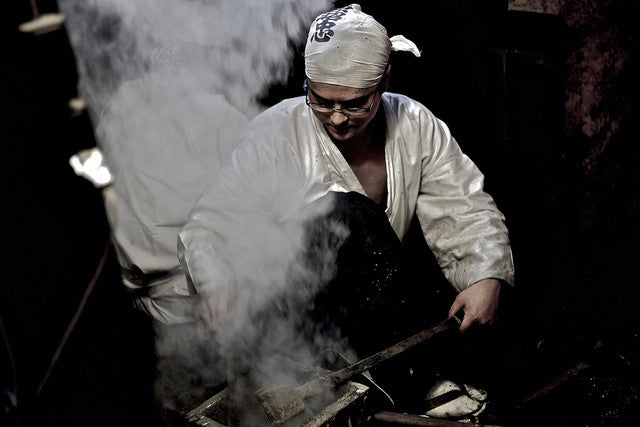

The Japanese katana is characterized by its slight curved blade. Previous generations of traditional Japanese swords featured a more significant curved blade or a straight blade. However, swordsmiths soon discovered that adding using a slight curve improved the sword's cutting power and efficiency, particularly against unarmored opponents.
Steel
It's important to note that katanas are made of steel, with traditional swordsmiths having used a special type of steel known as tamahagane steel. Prior to this period, Rome and other civilizations made swords out of bronze, which were made in a cast mold instead of forging. The advent of steel metallurgy opened the doors to a whole new world of possibilities regarding swords and weaponry. Steel swords could be forged without breaking or otherwise damaging the blade -- a characteristic lacking in bronze swords.
So, how exactly do swordsmiths make the katana's blade with a slight curve? Some people assume that it's made through hammering, with the swordsmith smashing a large hammer against the fiery-hot blade until the desired curvature is achieved. However, this isn't necessarily true.
Quenching
Katanas receive their distinct curved blade not from forging but from quenching. As we've discussed in previous blog posts, katanas are made by smelting multiple layers of steel sheets with varying levels of carbon. This reduces impurities while evenly distributing the carbon content throughout the blade. When creating these layers, the swordsmith stretches and folds the layers of steel to create a block of steel, which is then formed into a billet.
At the billet stage, the katana has virtually no curvature. It's not until the quenching process when it receives its curvature. While specific processes vary, traditional Japanese swordsmiths often coated the blade with clay. Next, he or she would place the blade in the forge; thus ,heating the carbon and fusing it to the steel. The swordsmith would then quench the blade in either water or oil to cool it.
Exposing the hot blade to the cold oil or water -- a process known as quenching -- resulted in rapid cooling, causing the clay-coated steel to form a super-strong material known as martensite. Because the katana's blade was typically made thinner around the cutting edge, it heated and cooled at a different rate than the rest of the blade. The nuances in this heating and cooling rate essentially caused different shrinkage rates. And this is how the katana receives its curved blade.
Photo credit: moriakitsuri

Toyotomi Hideyoshi's 1588 order to collect farmers' weapons: what the edict said, how it was carried out, and why historians see it as a change of status more than disarmament.

Where handle rattles come from, how to check safely, when a mekugi needs replacing, and when to stop using the sword.

Around 170 Viking-age blades bear the name Ulfberht. Microscope studies show some were made of crucible steel and many were copies. Here is what we know.


