
Your Cart is Empty



The traditional Japanese martial art Kendo is practiced by nearly half a million people in Japan alone. According to the "The Concept and Purpose of Kendo" by the All Japan Kendo Federation (AKF), Kendo is a " way to discipline the human character through the application of the principles of the katana."
The katana isn't used in kendo anymore. During the Edo period (1603 to 1868), practitioners transitioned from real swords to wooden and bamboo swords in effort to reduce injury. Prior to this time, practitioners of kendo and other forms of Japanese martial arts often sustained injury while training. Thankfully, injuries were almost eliminated by introducing practice swords.
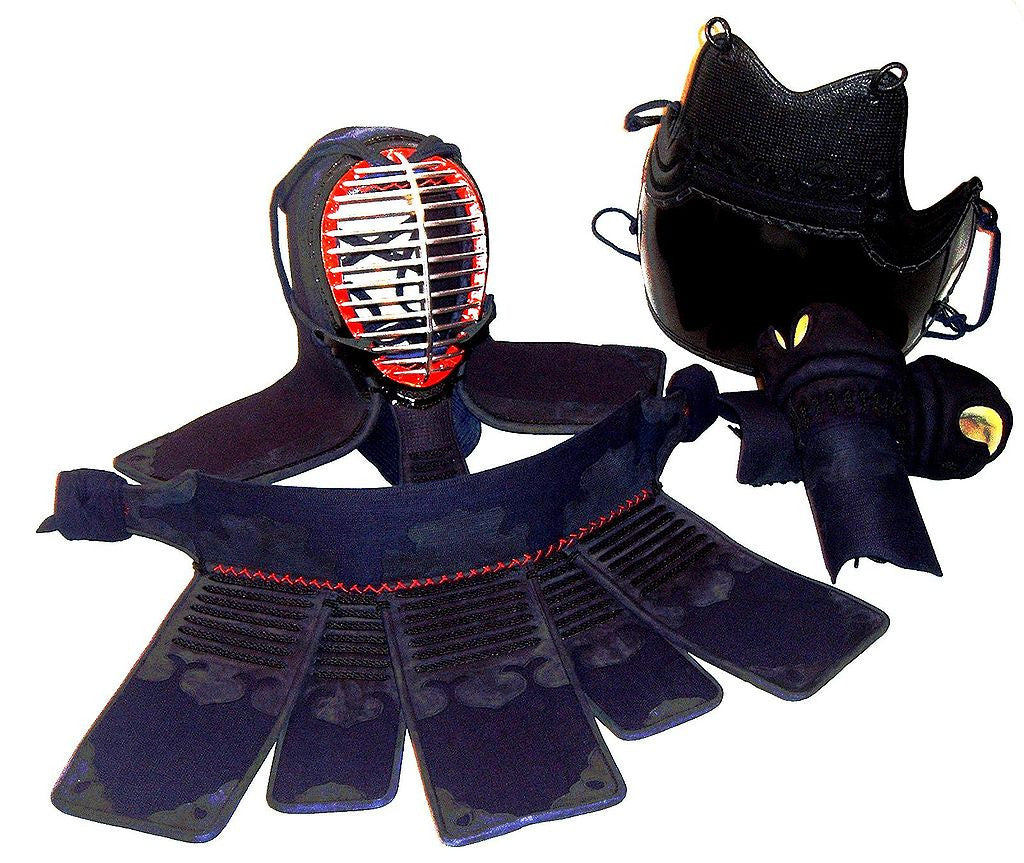
In addition to using practice swords, practitioners also began using body armor, known as bōgu. There are actually four pieces of bōgu used in kendo, each of which has its own specific purpose.
#1) Men
Similar to the mesh-wire mask worn in fencing, the men is a large helmet with protective padding on the shoulders. It's designed to protect the practitioner's face, neck and shoulders from injury. The men is secured to the practitioner's head and upper body by cords that wrap around the back. The back of the men, however, is open to allow for ventilation.
#2) Kote
A surprisingly large number of injuries in Japanese martial arts occur to the practitioner's hands, which is why kote are worn. Kote are gloves that resemble large, protective mittens. There are several types of kote, including those designed for kendo, as well as those designed for naginatajutsu, the latter of which feature less padding so the practitioner can move his or her hands more freely. Both types, however, allow practitioners to grip their practice sword.
#3) Dō
The dō is the primary piece of body armor that protects the practitioner's torso. It consists of a curved stomach protector that's designed to direct blows away from the middle part of the chest. Most dō are comprised of bamboo materials, though some is made of fibre or plastic. The dō is secured to the practitioner's body using ties on the back.
#4) Tare
The fourth and final piece of bōgu armor is the tare. This is essentially a thick belt with flaps on the front. In addition to protecting the practitioner's waist and upper legs, the tare also reveals the practitioner's identity. The center most flap on the tare usually contains a name tag revealing his or her name.

Toyotomi Hideyoshi's 1588 order to collect farmers' weapons: what the edict said, how it was carried out, and why historians see it as a change of status more than disarmament.

Where handle rattles come from, how to check safely, when a mekugi needs replacing, and when to stop using the sword.

Around 170 Viking-age blades bear the name Ulfberht. Microscope studies show some were made of crucible steel and many were copies. Here is what we know.


Eva Walsh
March 01, 2026
My grandson 12 years old is fascinating Japanese Kendo. I would like to buy for him 4 item of kendo bargain sales not expensive suit with mask in Ireland. Could be used for 170 cm . Thank you very much