
Your Cart is Empty


Few Japanese swordsmiths are as famous outside Japan as Muramasa, and almost none are as misunderstood. In novels, games and films his blades are cursed swords that thirst for blood. The real Muramasa was a working smith, or rather a family of smiths, in a busy port town, whose swords were valued by the very clan that later became linked to the curse. Here is what the record shows, and where the legend takes over.

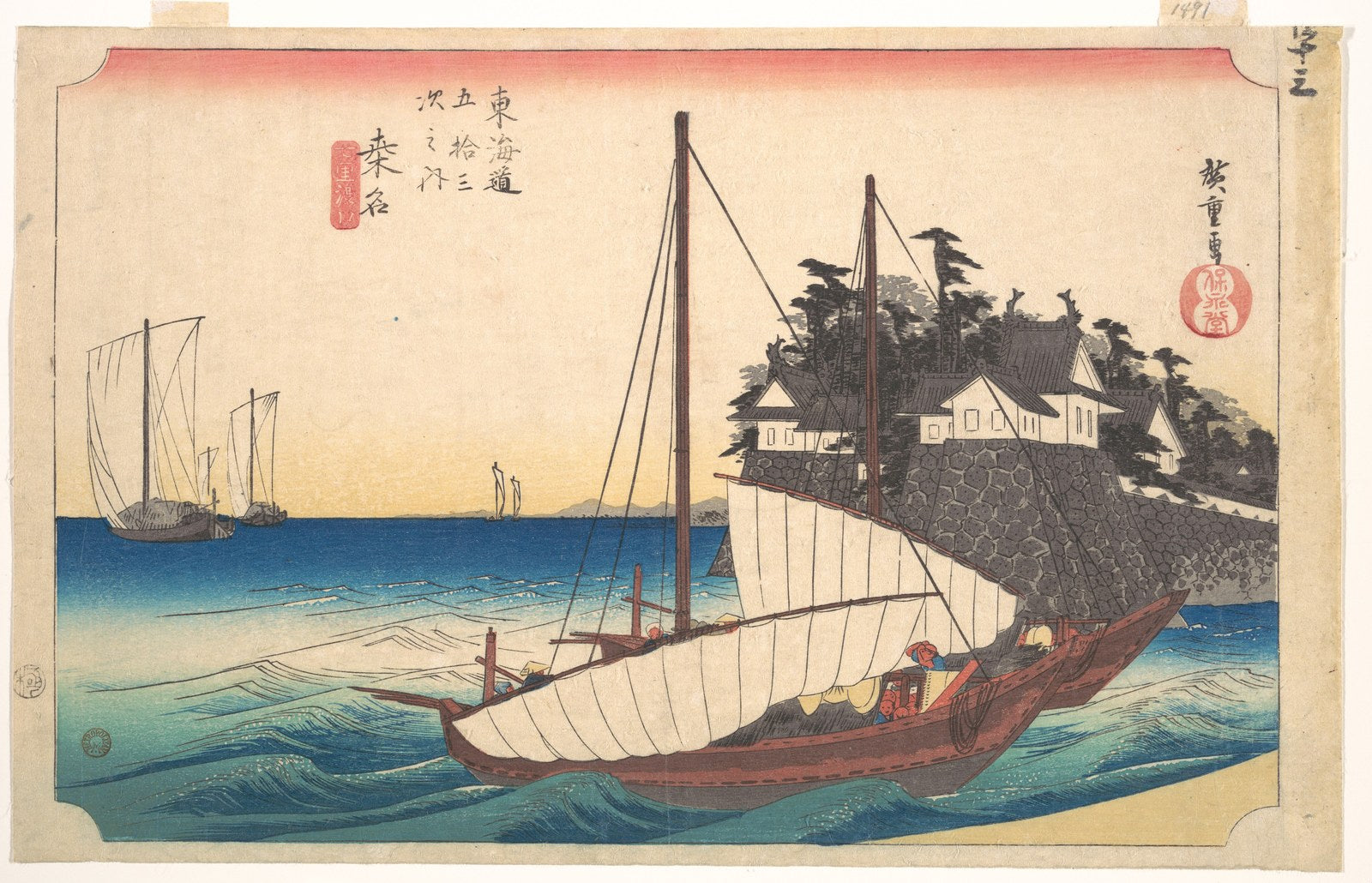
Kuwana, the port town in Ise Province where the Muramasa smiths worked. Utagawa Hiroshige, from the Fifty-Three Stations of the Tōkaidō, about 1833 to 1834. The Metropolitan Museum of Art, public domain.
Muramasa worked in Kuwana, in Ise Province (today part of Mie Prefecture), during the Muromachi period. The earliest blade bearing his name with a date is from 1501, and some undated work may be earlier. The name then continues on sword tangs for a long time: blades signed Muramasa carry dates as late as the 1660s. For that reason historians treat Muramasa as a school spanning at least two or three generations rather than a single man. The sword scholar Satō Kanzan, for example, proposed three generations working around 1489 to 1501, 1532 to 1539 and 1573 to 1591.
The school also included smiths working under other names. One of the most important was Masazane, whose signed katana dated to the eighth month of 1526 is now in the Metropolitan Museum of Art.

Katana blade signed by Masazane of the Muramasa school, dated 1526. The Metropolitan Museum of Art, public domain.
Muramasa blades are recognized by a few traits that appraisers still look for. The temper line ( hamon) is usually a wavy gunome-midare pattern with long, shallow valleys between clusters of rounded peaks, and the pattern on one side of the blade often matches the other side closely. The tang ( nakago) has a distinctive tapering outline known as tanago-bara, the "fish belly" shape. The school's swords had a reputation in their own time as sharp, practical fighting blades, which helps explain why so many warriors in the region carried them.
The curse legend grows out of a series of misfortunes in the family of Tokugawa Ieyasu, the warlord who founded the Tokugawa shogunate in 1603. Later accounts say:
These incidents appear in sources such as the Tokugawa Jikki, the shogunate's official chronicle, which was compiled between 1809 and 1849, long after the events. The Kuwana municipal library notes that the swords involved are not always clearly identified, so it cannot be said for certain that every one was a Muramasa. It also offers a simple explanation: Muramasa blades were popular with warriors around Okazaki in Mikawa, the Tokugawa home province, so they were bound to turn up in the family's troubles.
By the Edo period, avoiding Muramasa had become a custom among Tokugawa retainers, and some owners are said to have altered or removed the signatures on their blades to stay out of trouble. The popular image of Ieyasu issuing a formal ban, however, has no known supporting document.
The dramatic version came from the stage. Kabuki plays from the late 18th century onward, including Kagotsurube Sato no Eizame in 1888, showed Muramasa blades as swords that drove their owners to murder. In the final years of the shogunate, anti-Tokugawa activists sought Muramasa blades as a statement of opposition, and forgeries were made to meet the demand.
Another popular tale says Muramasa was a pupil of Masamune, the great smith of Sagami, and lost a contest to him. It is a legend and cannot be true: Masamune worked around 1300, about two centuries before the earliest dated Muramasa. (You can read more about Masamune in our article What was Masamune?)
The strongest evidence against the curse comes from the Tokugawa family itself. The Tokugawa Art Museum in Nagoya holds a katana signed Muramasa that belonged to Ieyasu. It was among the belongings divided after his death and passed to his ninth son, Yoshinao, the first lord of the Owari branch of the family, which kept it as an heirloom. It is an unusual Muramasa, with a hitatsura temper covering almost the whole blade, and the museum presents the curse story as folklore.
In 2016 the Kuwana City Museum held an exhibition on the Muramasa smiths that set out to separate the truth from the fiction of the "cursed sword", and it drew the largest attendance in the museum's history. The picture that emerges is of a capable regional school whose blades were prized by warriors, including the shogun's family, and whose name was later borrowed for a good story.
The legend has a practical consequence. Because Muramasa was famous and in demand, false signatures ( gimei) were made in the Edo period and later. A signature alone proves nothing, and a blade offered as a Muramasa needs examination and papers from a recognized appraisal body before it is taken seriously.
If what draws you is the look rather than the name, the Muramasa school's lively, wavy temper line is a style that modern swords can echo. Browse our Japanese sword collection to compare hamon and blade shapes, and ask us if you would like help choosing.

What nagasa, sori, motohaba, kasane, tsuka length, weight and balance point mean, how each is measured, and how to compare two swords fairly.

What the habaki, tsuba, tsuka, menuki, fuchi, kashira and saya actually do, and how to choose each one when you design a custom katana. Illustrated with museum pieces from the Metropolitan Museum of Art.


