
Your Cart is Empty


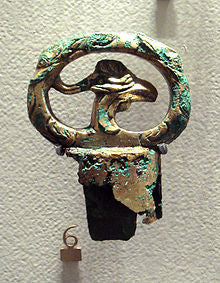

Also known as the ring-pommeled sword, the Hwandudaedo is the earliest type of Korean sword. It receives its namesake because of the circular fitting (pommel) at the top of the handle where it joins with the blade.
Like other early Asian swords, the Hwandudaedo featured a straight, double-edged blade. At the time, this was believed to be the most effective design for swords, as swordsmiths hadn't yet perfected the art of heat treating swords to achieve a stronger curved blade.
Origins of the Hwandudaedo
The Hwandudaedo first appeared on the Korean Peninsula during the transition from the Bronze to Iron Age, which occurred around the 1st century BC. With iron becoming more readily available, Korean armies could be better equip themselves with swords such as the Hwandudaedo. However, the Hwandudaedo didn't see widespread use among Korean soldiers until several centuries later.
Historians believe the Hwandudaedo was initially rare, with the sword being reserved for members of the royal family. It wasn't until the 3rd century when it became more widespread and viewed as "practical" weapon rather than a status symbol. In the following 4th and 5th centuries, the Hwandudaedo was the most common sword type on the Korean Peninsula. While still owned by members of the royal family, it was also used on the battlefield by Korean soldiers.
Different Types of Hwandudaedo
There were several different types of the Hwandudaedo, most of which are characterized by their decoration. See below for a list of some of the most common types of the Hwandudaedo and their respective decorations.
Because they were often given to members of the royal family, the Hwandudaedo featured numerous decorations, typically around the pommel. Korean swordsmiths acknowledged the importance of creating visually attractive swords, so they included the aforementioned designs into the Hwandudaedo's pommel rings.
You can see an example of the Hwandudaedo's decorative pommel in the photo above. According to Wikipedia, this photo depicts a Hwandudaedo from the Silla Kingdom -- one of the Three Kingdoms of Korea -- from between 4th and 6th century.
So, what happened to the Hwandudaedo? Around the turn of the 6th century, this once popular sword began to decline, giving way to other sword types.

Toyotomi Hideyoshi's 1588 order to collect farmers' weapons: what the edict said, how it was carried out, and why historians see it as a change of status more than disarmament.

Where handle rattles come from, how to check safely, when a mekugi needs replacing, and when to stop using the sword.

Around 170 Viking-age blades bear the name Ulfberht. Microscope studies show some were made of crucible steel and many were copies. Here is what we know.


