
Your Cart is Empty


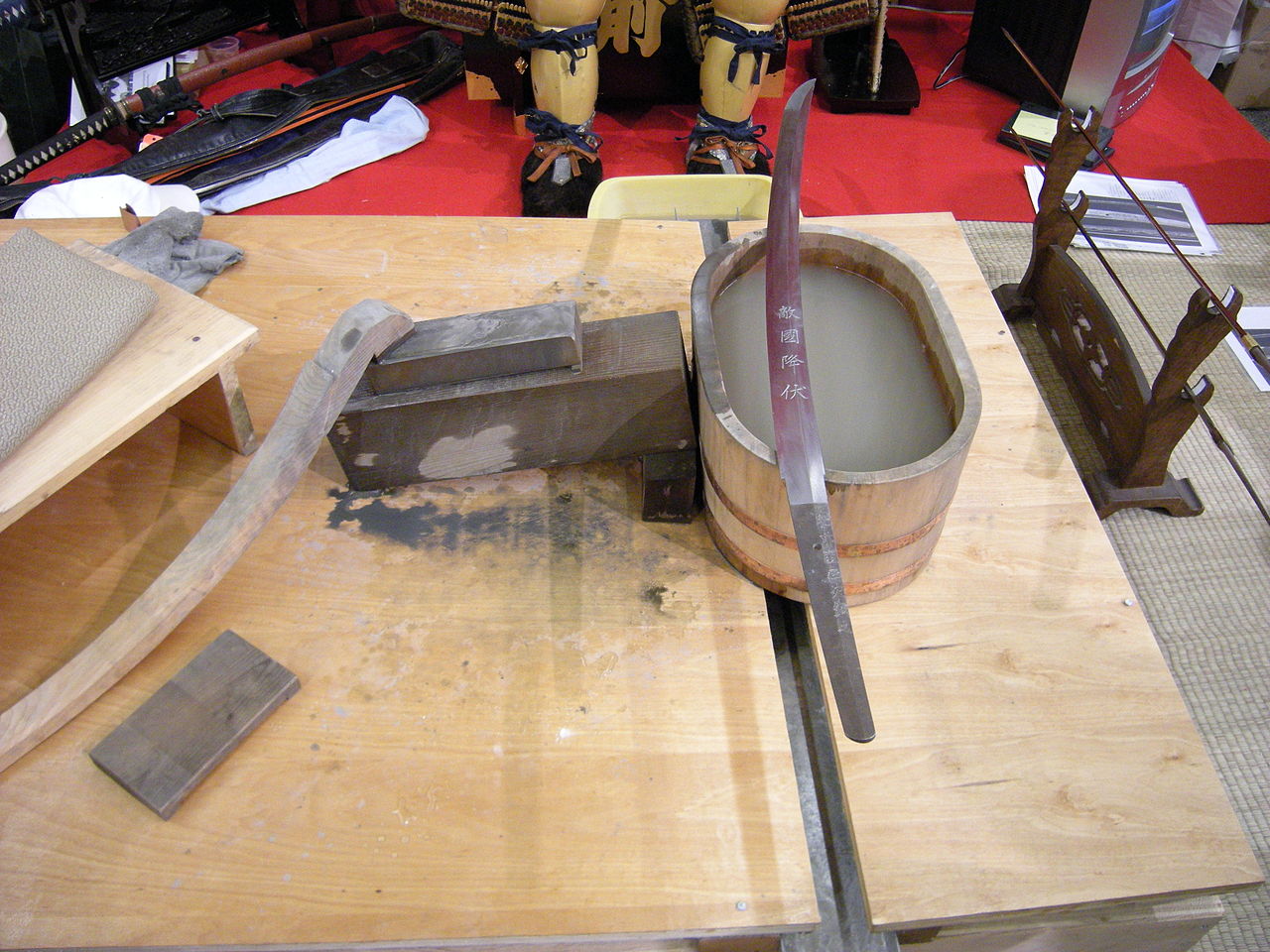

Swords like the katana and wakizashi aren't manually hammered to achieve their curved blade. While hammering is a step in the bladesmithing process, these swords receive their curvature from a separate process known as differential hardening. For centuries, bladesmiths have used differential hardening to turn otherwise straight blades into curved blades. The way in which they performed differential hardening, however, has evolved over the years. So, what's the difference between traditional and modern differential hardening?
Traditional Differential Hardening Explained
In feudal Japan, bladesmiths discovered that by heating and cooling the spine and edge of a sword at different rates, they were able to create curved blades. This was the earliest form of differential hardening, allowing bladesmiths to produce some of the world's finest curved swords, including the katana.
During this traditional form of differential hardening, bladesmiths would coat the sword's spine in a thick layer of clay, while placing little or no clay on the edge. While the sword is still hot, bladesmiths would then quench it in water or oil. Because of the thick layer of clay on the spine, this area cooled more slowly than the edge, thus forcing the sword to bend into a curved shape.
Modern Differential Hardening Explained
Although there are still bladesmiths who perform traditional differential hardening, there are now newer and more modern techniques used to create curved blades. Flame hardening, for example, is a modern differential hardening process that involves heating a specific portion of the sword -- typically the edge -- and then quenching it in water or oil. The heated section of the sword is converted into hard martensite, while the spine remains relatively unchanged.
Another modern differential hardening process is induction. It's called "induction hardening" because it relies on the use of induction coils to heat the blade. Also known as spark coils, induction coils are heating elements that quickly heat up the blade. And as with other differential hardening processes, induction hardening involves quenching the sword in water or oil after it has been heated.
Whether it's traditional or modern, all differential hardening processes can be used to create a curved blade. However, they also change the physical properties of the blade. When differential hardening is performed, the blade's spine typically becomes flexible, while the blade's edge becomes stronger and more durable. The end result is a sword with a flexible spine that can flex under pressure and a strong edge that's able to stay sharp.

Toyotomi Hideyoshi's 1588 order to collect farmers' weapons: what the edict said, how it was carried out, and why historians see it as a change of status more than disarmament.

Where handle rattles come from, how to check safely, when a mekugi needs replacing, and when to stop using the sword.

Around 170 Viking-age blades bear the name Ulfberht. Microscope studies show some were made of crucible steel and many were copies. Here is what we know.


