
Your Cart is Empty


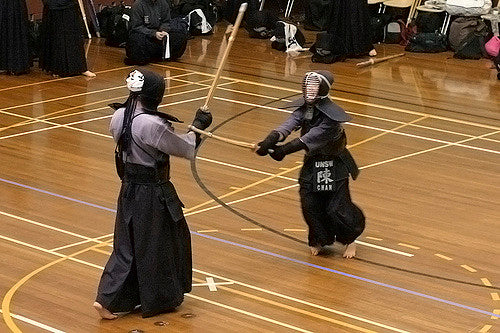

Kumdo, also known as Geomodo, is a modern style of Korean martial arts. Meaning "the way of the sword," it involves the use of protective armor and practice swords between multiple practitioners. In this post, we're going to explore Kumdo while revealing six interesting facts about this popular Korean martial art.
#1) It Was Derived From Kendo
While Kumdo is a Korean martial art, historians believe it was derived from Japanese kendo. In the late 1800s, Japan introduced kendo to Korea as a form of police training. Korean police officers would practice kendo to improve their skills. In the years to follow, however, the popularity for this sport spread; thus, leading to the development of a new style of martial art known as Kumdo.
#2) Multiple Opponents
One of the primary differences between kendo and Kumdo is that the former involves one-on-one sparring, whereas the latter often involves multiple opponents. This is because Kumdo is designed to train practitioners how to handle themselves on the battlefield. In traditional warfare, it was rare for a warrior to face a single opponent. Rather, he often faced multiple opponents on the battlefield. Kumdo acknowledges this element by requiring practitioners to face multiple opponents.
#3) 10 Ranks
There are 10 ranks in Korean Kumdo. When starting out, practitioners begin at the lowest rank, the 10th geup. As a practitioner becomes more efficient and adept, however, his or her Kumdo rank will progress to the 9th geup, 8th geup and so on, up to the 1st geup. Above the geup ranks are the dan grades, which are reserved for the most skilled practitioners of the sport.
#4) Shorter Version of the Katana
The wooden practice used in Korean Kumdo is similar to a traditional Japanese katana but with a few nuances. For starters, it features a wooden blade rather than a steel blade. Secondly, it's roughly 2 to 3 inches shorter than the katana. Finally, the practice sword used in Kumdo has less curvature than its katana counterpart.
#5) Kumdo Practitioners Compete in Kendo
You might be surprised to learn that Korean Kumdo practitioners compete in kendo competitions. Every three years, Korea sends a Kumdo team to Japan's World Kendo Championships (WKC). In the 13th WKC, Korea's Kumdo team defeated the United States in the men's championships. This was the first time the Kumdo team had won the championship.
#6) Points are Awarded for Successful Strikes
As with other forms of swordsmanship-based martial arts, Kumdo practitioners are awarded points for successfully striking an opponent. A typical engagement lasts five minutes, during which practitioners attempt to strike their opponents using a wooden practice sword. Successful strikes on an opponent result in points, and the practitioner with the most points wins the match.

Who the Muramasa smiths really were, how their blades became linked to the Tokugawa family's misfortunes, and why historians treat the curse as legend.

What nagasa, sori, motohaba, kasane, tsuka length, weight and balance point mean, how each is measured, and how to compare two swords fairly.

What the habaki, tsuba, tsuka, menuki, fuchi, kashira and saya actually do, and how to choose each one when you design a custom katana. Illustrated with museum pieces from the Metropolitan Museum of Art.


