
Your Cart is Empty


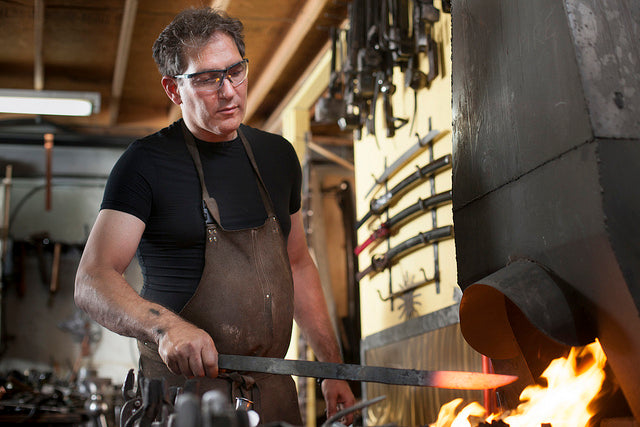

Swordsmiths in feudal Japan pioneered a swordmaking technique that has become instrumental in creating high-quality swords with a curved blade. Known as differential heat treatment, it involves heating and cooling different parts of the blade at different rates; thus, resulting in a hard edge and soft spine.
It's a little-known fact, however, that differential heat treatment was performed for both functional and aesthetic purposes. So, if you're interested in learning why this technique was such a crucial step in Japanese swordmaking, keep reading.
Functional Differential Heat Treatment
Several centuries ago, Japanese swordsmiths discovered that cooling different parts of a sword at different rates resulted in some unique qualities. By applying mud or clay to the spine, for instance, it cooled more slowly than the edge of the blade. This resulted in a soft spine made of pearlite, allowing the sword to flex and bend without breaking or otherwise sustaining damage.
Without clay on the edge, however, it cooled more quickly than the spine. As the metal cools, it turns into a stronger and harder composition known as martensite. With differential heat treatment, Japanese swordsmiths were able to produce katanas with sharp, strong edges that were still somewhat flexible. But differential heat treatment was also performed for aesthetic purposes...
Aesthetic Differential Heat Treatment
While differential heat treatment was initially performed strictly for functional purposes -- as described above -- Japanese swordsmiths soon discovered that it could be used for aesthetic purposes as well.
The famous Japanese swordsmith Amakuni Yasutsuna, who according to legend produced the first single-edged tachi with a curved blade, reportedly used differential heat treatment to decorate his swords. Basically, differential heat treatment creates distinct visual designs known as hamons. These designs appear as an outline separating the areas where differential hardening occurred.
According to Wikipedia, some Japanese swordsmiths in sixteenth century AD began to intentionally overheat their swords before quenching them in water to produce larger and more visible hamon lines. This didn't offer any benefit in terms of strength or durability. On the contrary, this actually made them slightly weaker. Nonetheless, some swordsmiths during this era preferred the unique visual style of prominent hamon lines on their swords.
The craft of creating hamon lines through differential heat treatment in feudal Japan continued, with more and more swordsmiths using the method in their own work. The craft was gradually perfected by shaping the clay. And even today many swordsmiths continue to use differential heat treatment for aesthetic purposes such as this.
Photo credit: NAIT

Who the Muramasa smiths really were, how their blades became linked to the Tokugawa family's misfortunes, and why historians treat the curse as legend.

What nagasa, sori, motohaba, kasane, tsuka length, weight and balance point mean, how each is measured, and how to compare two swords fairly.

What the habaki, tsuba, tsuka, menuki, fuchi, kashira and saya actually do, and how to choose each one when you design a custom katana. Illustrated with museum pieces from the Metropolitan Museum of Art.


