
Your Cart is Empty


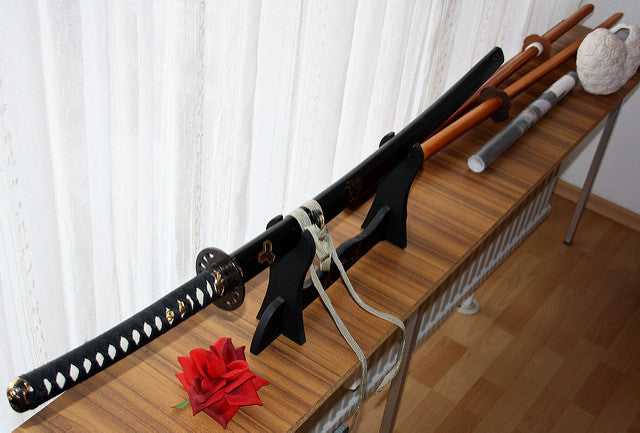

With its curved, single-edged blade, the katana is one of the most recognizable swords in the world. Originating sometime during Japan's Kamakura period (1185 to 1333), it offers a superior level of quality when compared to other swords.
One of the reasons for the katana's popularity is its curved blade. While other swords like the tachi also featured a curved blade, the katana's moderate curvature made it a formidable weapon on the battlefield.
Differential Heat Treatment and Quenching
It's a common assumption that the katana's curved blade is created through forging. Granted, forging plays a key role in the katana's construction, but it's not responsible for the sword's curvature. The katana -- like other traditional Japanese swords -- received its curved blade from a swordmaking process known as differential heat treatment.
To create the katana's curved blade, the swordsmith would coat the spine with clay while leaving the edge bare and exposed. Next, the swordsmith would quench the blade in oil or water to cool it. With the spine covered in clay, however, it cooled more slowly than the edge. This nuance in temperature allowed for different rates of shrinkage, which ultimately led to the formation of a curved blade.
Why Swordsmiths Designed the Katana With a Curved Blade
Japanese swordsmiths discovered that swords with a curved blade were more effective than those with a straight blade. This is why most traditional Japanese swords feature a single-edged, curved blade like the katana. Thanks to its curved blade, samurai warriors could perform slashing attacks is a fast and fluid manner with little to no interruption.
The katana's curved blade also protected the sword from damage. Through differential heat treatment, Japanese swordsmiths could create a sword with a strong edge and a flexible spine. This was important because it allowed the spine to flex while still retaining a strong, sharp edge.
Furthermore, the katana's curved blade allowed samurai warriors to unsheathe and draw their sword more quickly. They could pull the katana up from its sheathe in a natural motion without worrying about it getting stuck or caught.
Even after all those years, a curved blade remains a key feature found in many modern-day swords. Whether it's a katana, wakizashi or even European swords, you'll often discover that they have a curved blade. This otherwise simple feature creates a more effective weapon while also protecting the sword from damage.

The kris is a weapon, an heirloom and a sacred object. How to read its blade, how pamor patterns are made, who the empu are, and why UNESCO recognized it.

How to choose a sword for someone else: matching it to their art, sizing it without spoiling the surprise, useful extras, and lead times for custom work.

How to size an iaito for your height, weigh alloy against steel, judge the handle and fittings, and what to ask your sensei and the seller first.


