
Your Cart is Empty


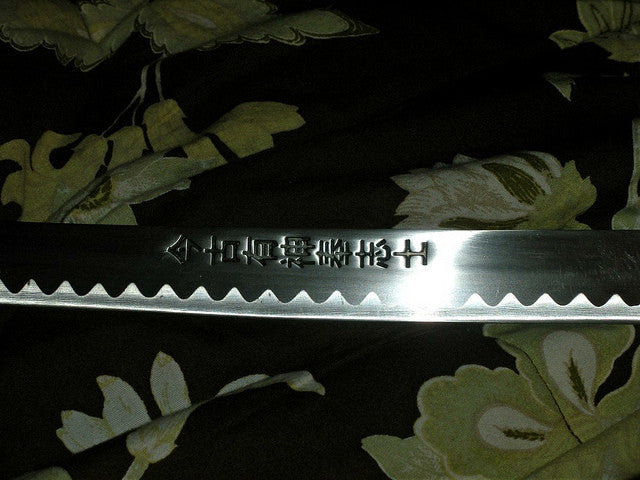
 There's no disputing the fact that Japanese katanas are some of the world's finest quality swords. Over the course of several centuries, Japanese swordsmiths perfected the craft of forging blades. In addition to transitioning to curved-edge swords, they also pioneered several new types of the steel that enhanced the properties of the katana and other swords, allowing for more effective weaponry.
Martensite
Named after German metallurgist Adolf Martens, martensite is a type of hard crystalline steel that's created through diffusionless transformation. It's formed by rapidly cooling (quenching) hot steel; thus, preventing the atoms from diffusing out of the crystalline structures. Normally, the edge of katanas and other traditional Japanese swords consists of martensite.
To improve its resistance, however, Japanese swordsmiths temper martensite. Doing so increases its resistance to shock, making it less likely to break upon impact. The final product -- tempered martensite -- maintains the perfect balance of exceptional strength and flexibility.
Pearlite
Another type of microstructure created by Japanese swordsmiths is pearlite. Pearlite was originally identified by Henry Clifton Sorby, whom named it sorbite. It was later renamed to "pearlite," however, because of its similarity to the microstructures of nacre, which resembles that of pearls.
Like martensite, pearlite is created by quenching steel, usually with water or oil. However, the key difference between it and martensite lies in the rate at which it is cooled. Pearlite is cooled more slowly than its martensite counterpart, making it softer and easier to bend.
Pearlite is typically found in the blade's hamon, where it joins with the tempered martensite.
Bainite
A third type of steel that's created in the production of modern Japanese swords is bainite, which falls somewhere between martensite and pearlite. Bainite is a type of steel that's produced by cooling faster than pearlite but slower than martensite. Additionally, bainite has plate-shaped designs in its microstructures, while martensite has long oval-shaped designs.
Bainite is often preferred because it doesn't require tempering after being hardened. Bainite reaches its ideal strength after quenching, at which point it's strong, durable, and still able to absorb shock without breaking.
Martensite may technically be the hardest of the three steel types listed here. However, swordsmiths must temper it when using the metal to make swords. Without tempering, martensite is simply too hard, making it susceptible to breakage upon impact. This is why Japanese swords are often made with tempered martensite, tempered pearlite, or bainite (in case of modern Japanese sword like MAS) -- or even a combination thereof.
Photo credit: Joe Monin

The bows, carrying positions and ways of passing and placing a sword taught in many dojo, and why schools differ.

Who the Muramasa smiths really were, how their blades became linked to the Tokugawa family's misfortunes, and why historians treat the curse as legend.

What nagasa, sori, motohaba, kasane, tsuka length, weight and balance point mean, how each is measured, and how to compare two swords fairly.


