
Your Cart is Empty



Some of the world's most popular and well-known martial arts originated from Japan. Sumo wrestling, for example, has origins dating back to 23 B.C. Japan, whereas jujutsu originated during the early 20th century. Even if you're familiar with these two martial arts, though, there are probably other Japanese martial arts of which you've never heard, such as naginatajutsu. In this post, we're going to reveal five fun facts about naginatajutsu.
#1) It Focuses Specifically on Wielding the Naginata
While other forms of Japanese swordsmanship involve the use of multiple weapons, naginatajutsu focuses specifically on wielding and using a single weapon: the naginata. Resembling a polearm -- such as the European glaive -- the naginatajutsu is long, heavy and difficult to maneuver. Naginatajutsu, however, teaches practitioners the art of wielding the naginata.
#2) The Naginata Was Extensively Against Horseback Invaders
The naginata proved to be highly effective against invaders on horseback. During Japan's feudal period, the region was under constant attack by invading Mongolians. To defend their land, samurai warriors would often use the naginata to attack invaders on horseback from a safe distance. Because of its long length, the naginata allowed samurai warriors to engage their opponents from several feet away.
#4) It Was Practiced By Women in Feudal Japan
It wasn't just men who practiced naginatajutsu in feudal Japan; women practiced it as well. In fact, there were a significant number of female naginatajutsu practitioners during this time. This was because women sought the naginata as a form of personal protection when their husband was away. In order to use the naginata, though, women had to learn how to wield and handle it, drawing them to the martial art naginatajutsu. This resulted in a significantly high ratio of female to men practitioners.
#5) It's Still Practiced In Japan
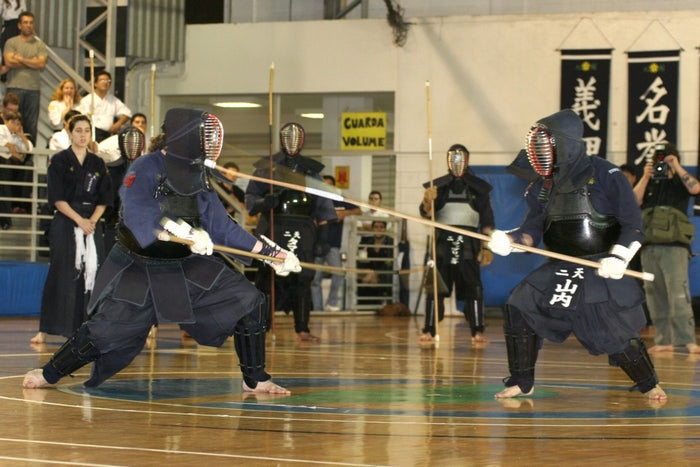
Even after all those years, naginatajutsu is still practiced by thousands of people in Japan as well as the United Kingdom, the United States, Australia and several other countries. Today, however, it's practiced primarily using the same protective armor as kendo. As shown in the photo above, practitioners wear suits of body armor to protect themselves from injury. Furthermore, naginatajutsu today uses practice naginata made of bamboo rather than actual naginata with a live metal blade.
Naginatajutsu is just one of many martial arts that originated in Japan. It's unique, however, in the sense that it focuses specifically on the naginata.

Toyotomi Hideyoshi's 1588 order to collect farmers' weapons: what the edict said, how it was carried out, and why historians see it as a change of status more than disarmament.

Where handle rattles come from, how to check safely, when a mekugi needs replacing, and when to stop using the sword.

Around 170 Viking-age blades bear the name Ulfberht. Microscope studies show some were made of crucible steel and many were copies. Here is what we know.


