
Your Cart is Empty


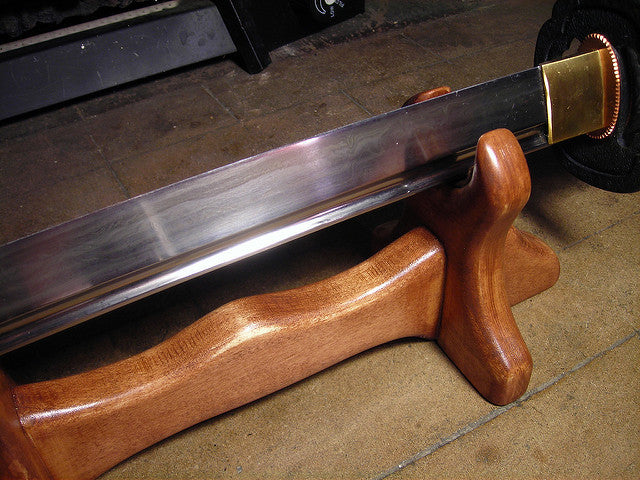

Regardless of how active you are in martial arts, your katana will probably spend most of the time on display -- and that's okay. A high-quality katana serves as a focal point, sparking conversation by anyone who sees it. But there are a few things you should know about displaying a katana.
The Katanakake
There are dozens of different display cases and stands in which you can place your katana. One of the most popular, however, is the katanakake. The katanakake is essentially a wooden stand with pairs of hooks that's designed to hold one or two swords. In feudal Japan, samurai warriors would place their swords on the katanakake before entering buildings, though this type of katanakake featured a slightly different design.
Cutting Edge Facing Up
Traditionally, Japanese swords like the katana are displayed the same manner in which they are worn. Because the katana is worn with the cutting edge facing up, it should also be displayed with the cutting edge facing up.
Some people assume that displaying swords with the cutting edge facing up helps to protect the blade from damage, but this isn't necessarily true. Displaying the katana with the cutting edge facing up is a means of "respecting" the sword. This dates back hundreds of years to feudal Japan, during which this was the standard way of displaying katanas. Since then, the tradition remains, with martial arts practitioners and sword collectors alike continuing to display their katanas in this manner.
Tsuka on The Left or Right?
From a functional point of view, displaying your katana with the tsuka on the left or right makes no difference. You can display your katana with the tsuka on either side without worrying about it negatively affecting the blade or other components.
With that said, traditional Japanese etiquette says that katanas displayed with the tsuka on the left signals peace, whereas displaying the katana with the tsuka on the right signals combat readiness and ability to fight. Assuming you display your katana in your home, either way is perfectly acceptable. However, if you're displaying it in a dojo you should ask your sensei for a recommendation.
Regardless of how you display your katana, it's important to clean, polish and oil it on a regular basis. Over time, dust, debris and moisture will settle on the blade, which can lead to rust. By cleaning and oiling your katana, however, you can protect it from damage such as this.
Photo credit: Justin Ruckman

Toyotomi Hideyoshi's 1588 order to collect farmers' weapons: what the edict said, how it was carried out, and why historians see it as a change of status more than disarmament.

Where handle rattles come from, how to check safely, when a mekugi needs replacing, and when to stop using the sword.

Around 170 Viking-age blades bear the name Ulfberht. Microscope studies show some were made of crucible steel and many were copies. Here is what we know.


