
Your Cart is Empty


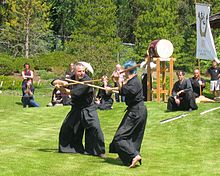

With origins dating back to the early days of feudal Japan, kenjutsu is one of the country's oldest forms of martial arts. Kenjutsu isn't a single type of martial arts, however. Rather, it refers to all forms of Japanese martial arts involve swordmanship, specifically those that predate the country's Meiji Restoration.
Overview of Nitōryū vs Ittō-ryū
Kenjutsu teachings are typically classified as either nitōryū vs ittō-ryū, depending on the number of swords used. In ittō-ryū, practitioners use a single sword. In nitōryū, however, practitioners use two swords. Although there are dozens of modern schools that teach the traditional Japanese martial art kenjutsu, they are all classified as either nitōryū vs ittō-ryū.
Nitōryū
Normally, ittō-ryū kenjutsu schools require practitioners to use a practice sword a bamboo shinai or wooden bokken. While some schools involve the use of real swords with a live blade, this practice has gradually been phased out in factor of practice swords to protect users from self-injury.
The practice swords used in ittō-ryū kenjutsu are usually designed to mimic the length and characteristics of the katana. Considering the katana was -- and still is -- the most popular style of Japanese swords, this shouldn't come as a surprise.
Ittō-ryū
As previously mentioned, the key difference between ittō-ryū and nitōryū is that the former involves one sword while the latter involves two swords. In ittō-ryū, kenjutsu practitioners typically use a wakizashi and shoto paired with a katana or daito.
With two swords instead of one, ittō-ryū is more difficult to learn. Practitioners must master the complexities of switching between their swords, which adds another barrier of difficulty to kenjutsu.
Which Style Is More Popular?
Both ittō-ryū and nitōryū are popular teachings in the traditional Japanese martial art kenjutsu. However, many practitioners prefer ittō-ryū because it's a more genuine and traditional style.
In feudal Japan, samurai warriors were required to carry two swords. This usually consisted of a short sword like wakizashi and a long sword like the katana. The practice of carrying two swords become so commonplace that it was even given a name: daisho. When translated, daisho means "big-little," which is an accurate definition of the term. Samurai warriors carried both a big sword and a little sword.
While the feudal days of Japan are long gone, many practitioners of the country's traditional martial arts carry on the practice of using two swords through ittō-ryū kenjutsu. Granted, using two swords is more difficult than using a single sword, but it accurately reflects Japan's history.

Toyotomi Hideyoshi's 1588 order to collect farmers' weapons: what the edict said, how it was carried out, and why historians see it as a change of status more than disarmament.

Where handle rattles come from, how to check safely, when a mekugi needs replacing, and when to stop using the sword.

Around 170 Viking-age blades bear the name Ulfberht. Microscope studies show some were made of crucible steel and many were copies. Here is what we know.


