
Your Cart is Empty


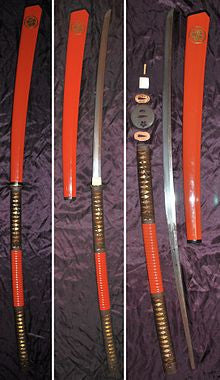

When you think of traditional Japanese swords, what's the first sword that comes to mind? For most people, it's the katana. The katana remains the most popular traditional Japanese sword, characterized by its single-edge, curved blade. However, there are other swords originating from this island nation, including the nagamaki.
Overview of the Nagamaki
The word "nagamaki" literally translates into "long wrap," which is a key characteristic of this traditional Japanese sword. It features a single-edged blade with a slight curve, much like its katana counterpart. It was also quite long, with the blade extending up to 2 feet. What made the nagamaki unique, however, was its handle.
As you can see in the photo above, the nagamaki featured a long handle. In fact, the length of the handle was often equal to the length of the blade. Furthermore, the handle wasn't just an ordinary wooden shaft in which the swordsmith mounted the blade. It closely resembled the katana's hilt, featuring multiple layers of wrapped leather, silk and/or other materials.
With that said, historians have discovered nagamaki swords featuring little-to-no wrappings around the handle at all, making it comparable to an exceptionally long tachi.
Are There Standard Measurements for the Nagamaki?
While swordsmiths have traditionally followed standard sizing and measurements when creating Japanese swords like the katana, tachi and koshirae, the nagamaki lacked these standards. This resulted in swordsmiths making the nagamaki in a varied of blade lengths, handle lengths, styles, etc. One particular style of nagamaki, the Arak-ryu, was over eight feet long, tipping the scales at eight pounds.
How the Nagamaki was Used
The nagamaki was used primarily by samurai warriors of feudal Japan. It's a two-handed sword, requiring warriors to hold it with both hands. The nagamaki was used primarily for attacks involving sweeping and slicing, for which it was particularly effective. It's long blade and equally long handle made it ideal for use against enemies on horseback.
Origins of the Nagamaki
Like many ancient swords, the exact origins of the nagamaki remain a mystery. However, some of the earliest evidence of this sword dates back to Japan's Heian period (794 to 1185). Historians also believe the sword reached its peak popularity during the middle of Japan's Muromachi period (1336 to 1573).
Reports indicate that Japan's infamous warlord Uesugi Kenshin was protected by an army of special guards equipped with nagamaki swords.
Are you interested in a custom sword like this? Please visit our custom sword builder, and if you do not find what you are looking for, then contact usabout your project. We can probably do it even if it is an unusual design.
Photo credit: SamuraiAntiqueWorld

Toyotomi Hideyoshi's 1588 order to collect farmers' weapons: what the edict said, how it was carried out, and why historians see it as a change of status more than disarmament.

Where handle rattles come from, how to check safely, when a mekugi needs replacing, and when to stop using the sword.

Around 170 Viking-age blades bear the name Ulfberht. Microscope studies show some were made of crucible steel and many were copies. Here is what we know.


