
Your Cart is Empty


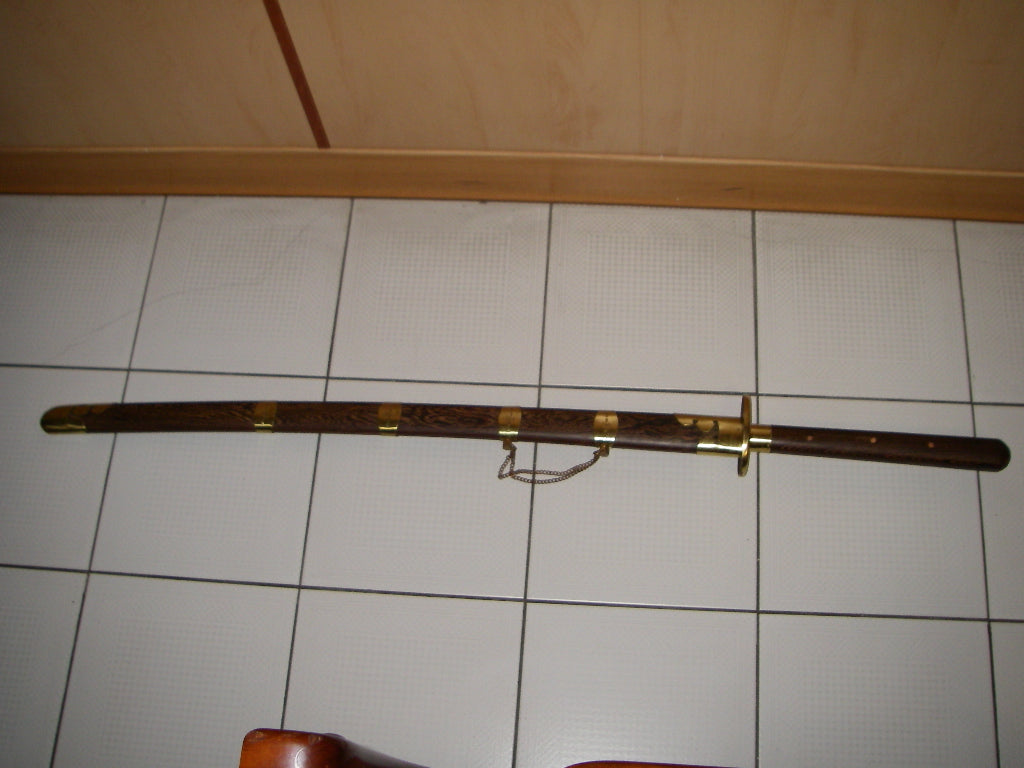

It's a little-known fact that Japan borrowed many of its bladesmithing practices from China. Before Japan pioneered its own techniques to make swords like the katana and wakizashi, it used the same techniques as its neighbor in China. For centuries, China has been a front runner in the art of bladesmithing, with one of the region's most popular swords being the miaodao.
What Is the Miaodao?
The miaodao was a two-handed sword with a curved blade produced during China's Republican era. As shown in the photo above, it was relatively long with an average blade length of about 47 inches (119 cm). This long length made it a formidable weapon on the battlefield. Throughout pre-modern China, warriors would use the miaodao to engage their enemies and defend their land.
The name "miaodao" translates from the Chinese language to "sprout saber." Of course, this is a fitting name given the sword's saber-like design. Sabers are generally characterized by a curved blade. With its moderately curved blade, the miaodao is a prime example of saber, hence the reasoning behind its name.
So, how does the miaodao relate to a sprout? As previously mentioned the name of this sword translates to "sprout saber." We've already discussed how the miaodao features a sabre-like design. Well, if you examine this traditional Chinese sword closely, you'll see that it also looks like a sprouted plant.
Miaodao vs Zhanmadao
Some people assume that the miaodao is the same as the zhanmadao. This isn't entirely wrong, though it's not completely accurate either. In recent years, the term "miaodao" has become interchangeable with "zhanmadao," with many people referring to both types of swords as either "miaodao" or "zhanmadao." During pre-modern times, however, miaodao referred to a specific type of saber-like sword with a blade length of about 47 inches (119 cm).
How the Miaodao Was Forged
The miaodao wasn't constructed using cast bronze. While many earlier Chinese swords -- as well as swords produced in Japan, Korea and Europe -- were designed using cast bronze, the miaodao appeared after the invention of steel. Chinese bladesmiths during the Republican era forged the miaodao by heating iron and carbon (coal) and hammering it into the shape into of a sabre-like sword. Steel swords such as the miaodao were superior to those made of cast bronze. Unlike their counterparts, steel swords could flex without breaking -- to some degree, at least. Therefore, steel quickly became the preferred metal for use in constructing the miadao and other swords.

Who the Muramasa smiths really were, how their blades became linked to the Tokugawa family's misfortunes, and why historians treat the curse as legend.

What nagasa, sori, motohaba, kasane, tsuka length, weight and balance point mean, how each is measured, and how to compare two swords fairly.

What the habaki, tsuba, tsuka, menuki, fuchi, kashira and saya actually do, and how to choose each one when you design a custom katana. Illustrated with museum pieces from the Metropolitan Museum of Art.


