
Your Cart is Empty


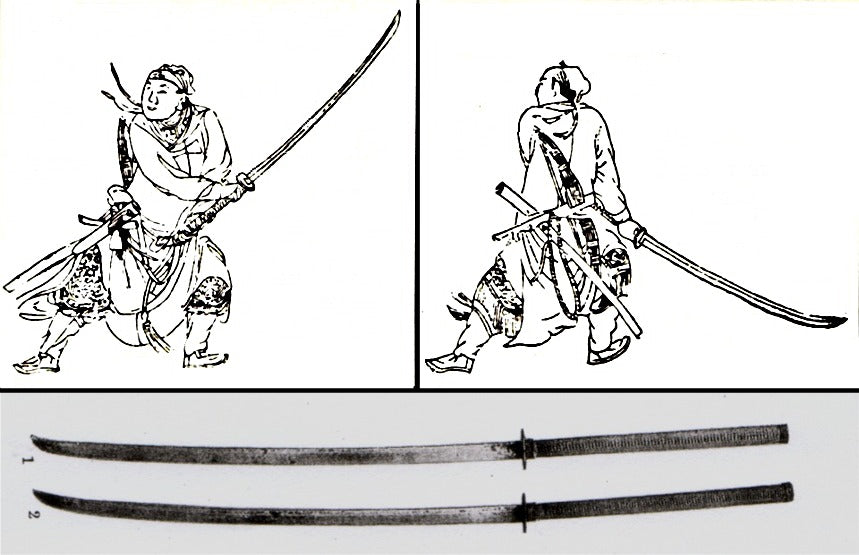

Some of the world's first swords were produced in China. While China has pioneered dozens of swords over the course of its 8,000-year-old history, one of its most prominent is the wodao. Meaning "sword of the wo people," it featured a long, thick blade, allowing for powerful strikes.
History of the Wodao
The wodao has origins dating back to China's Ming Dynasty (1368 to 1644). During this time, General Qi Jiguang embarked on a mission to push pirates out of China's coastal territories. Among other things, he relied heavily on the use of the wodao in his army's weaponry. Jiguang even wrote about the wodao in a military manual titled "Jixiao Xinshu," describing it as a powerful, heavy sword that gave his soldiers a competitive advantage over his enemies. With a surplus of wodao at his army's disposal, Jiguang was able to push the pirates out of China's coastal territories.
Overview of the Wodao
Although it was designed in a variety of sizes, most wodao featured a blade measuring about 31 to 35 inches (80 to 90 cm). Of course, this made it a pretty large sword compared to other Chinese and Japanese swords. With a 31- to 35-inch blade, the wodao was pretty heavy. This allowed for powerful strikes when wielded and used as a weapon, though at the cost of speed and maneuverability.
Like other traditional Chinese swords, the wodao featured a curved, single-edged sword. As shown above, it didn't have a prominent curve. Rather, it was a small curve that was just enough to improve the sword's versatility.
Because of its large size and heavy weight, Chinese warriors wielded the wodao using both hands instead of just one. In the early 1920s, Cao Kun formed a branch of the Chinese Army that specialized in using two-handed swords, such as the wodao. Known as the Miaodao branch, it focused on teaching soldiers how to effectively handle and use the wodao during combat.
The Wodao and the Tachi
The wodao shares several common characteristics with the Japanese tachi, including a similar blade length and a single-edged, curved design. In fact, some historians believe that the tachi was designed using the framework of the wodao. Considering that samurai warriors in Japan often used the wodao, this makes sense. As samurai warriors became proficient with the wodao, they probably sought to design their own sword, thus leading to the creation of the tachi.

How to size an iaito for your height, weigh alloy against steel, judge the handle and fittings, and what to ask your sensei and the seller first.

Toyotomi Hideyoshi's 1588 order to collect farmers' weapons: what the edict said, how it was carried out, and why historians see it as a change of status more than disarmament.

Where handle rattles come from, how to check safely, when a mekugi needs replacing, and when to stop using the sword.


