
Your Cart is Empty


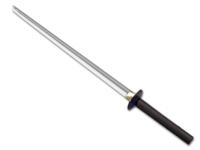

The ninjatō is a short, single-edged Japanese sword that's largely shrouded in mystery. Often portrayed as the preferred weapon of the ninja, and used by modern martial arts practitioners like Masaaki Hatsumi and Stephen Hayes, it's become widely recognized both in Japan and elsewhere. Nonetheless, there's a still a certain mysticism surrounding the ninjatō.
Ninjatō Specifications and Characteristics
The ninjatō differs from the katana in several ways. As shown in the photo above, it features a straight blade, whereas the Japanese katana features a distinct curved blade. In terms of length, the ninjatō is typically described as being roughly 23 inches (60 cm), featuring a square-shaped guard above the handle. It's also surprisingly lightweight, weighing just 0.93 pounds (0.42 kg).
According to Stephen Hayes, American martial arts practitioner and writer, the ninjatō featured a straight blade because it was easier for samurai warriors to forge themselves than a curved blade. Hayes further explains that samurai warriors would create ninjatō swords using slabs of steel or iron, after which they would grind the edge with a stone.
History and Origins of the Ninjatō
Surprisingly, though, there's no real evidence that the ninjatō existed from the Sengoku period to the Edo period. In fact, it wasn't until the mid-1960s when the ninjatō appeared in Japan's Ninja Museum of Igaryu. Fast forward to 1973 and the ninjatō appeared in advertisements for the magazine Black Belt. As exposure for the ninjatō grew, the sword began to appear elsewhere, including movies, TV shows, video games and more.
Because of its unknown origins, there's little known about the ninjatō's usage. And any reports on the sword's usage are subjective at best. With that said, the ninjatō -- when displayed in recent media -- is depicted in a similar way as the katana. Although the two swords differ, the ninjatō was also wielded and used like the katana, according to portrayals in recent media.
So, is the ninjatō a real sword or just another myth? It's safe to say that the ninjatō is currently a real sword in the sense that several companies produce and sell it. However, there's still no definitive evidence indicating that it existed during feudal Japan. Perhaps the evidence was lost over the years, or maybe the sword didn't appear until recently. That question remains open to debate, though the fact remains that the modern-day ninjatō is a real sword.
1

Who the Muramasa smiths really were, how their blades became linked to the Tokugawa family's misfortunes, and why historians treat the curse as legend.

What nagasa, sori, motohaba, kasane, tsuka length, weight and balance point mean, how each is measured, and how to compare two swords fairly.

What the habaki, tsuba, tsuka, menuki, fuchi, kashira and saya actually do, and how to choose each one when you design a custom katana. Illustrated with museum pieces from the Metropolitan Museum of Art.


