
Your Cart is Empty


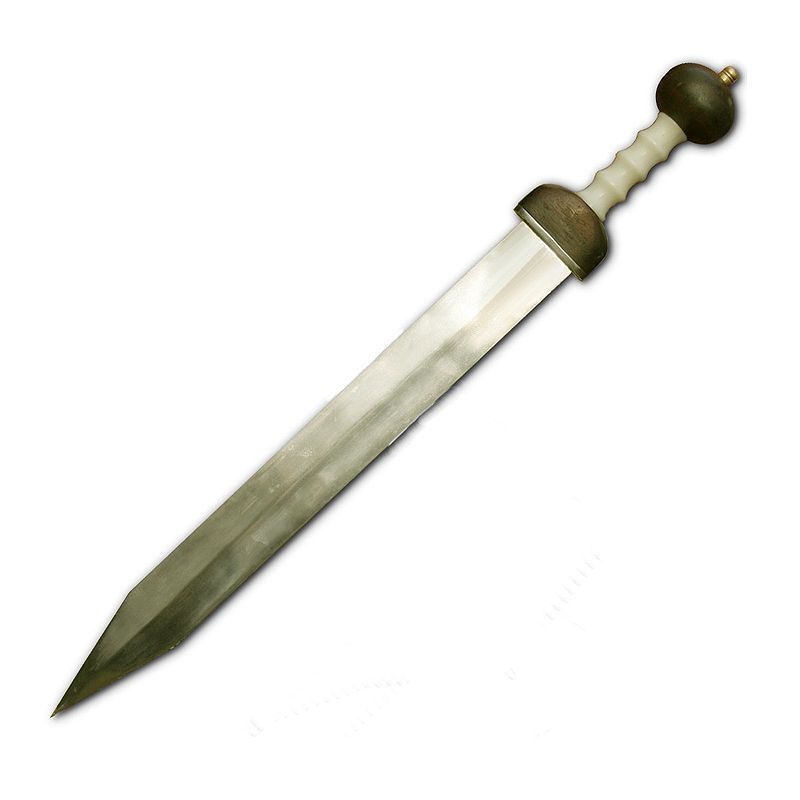

The gladius was the primary sword used by foot soldiers in Ancient Rome. Translated from the Latin language meaning "sword," it often made featured a bronze, steel or iron blade with an ivory or wood hilt.
Origins of the Gladius
Much of the gladius' origins remain shrouded in mystery. However, historians believe the sword first appeared sometime around the 4th century. Some of the first gladiuses were made of bronze, with swordsmiths casting the bronze metal into the shape of a blade rather than forging it. Not long after, swordsmiths began using iron to produce the gladius. Iron gladiuses were stronger and easier to produce than their bronze counterparts. Eventually, Roman swordsmiths began making the gladius with steel and high-carbon steel, which offered an even higher level of strength and overall quality.
Characteristics of the Gladius
While there are dozens of variations of the gladius, most shared a few common characteristics. Nearly all gladius swords, for instance, featured a double-edged blade. While other swords like the katana featured a single edge, the gladius was sharp on both edges. This increased its versatility, allowing Roman soldiers to attack opposing armies using either side of the sword's blade.
The gladius also featured a tapered point in which the blade became narrower towards the tip. It's believed that the gladius' tapered point made the sword an effective stabbing weapon. With that said, the gladius -- like most swords of its era -- were used primarily as a slashing weapon. This meant soldiers were required to inspect their gladiuses on a regular basis, ensuring the edges were sharp and not otherwise damaged.
Most Roman soldiers carried the gladius in a scabbard that was strapped to their shoulder or belt. It's unknown, however, how soldiers drew their gladius. Some reports suggest that soldiers unsheathed their gladius by reaching across their body. Others suggest that soldiers unsheathed their gladius by simply pulling it up using the hand closest to the sword.
Types of Gladiuses
There were dozens of different gladiuses produced throughout the history of Rome. However, the most common types were the gladius hispaniensis, Mainz gladius, Fulham gladius and the Pompeii gladius. The latter, the Pompeii gladius, was named after the town of Pompeii, in which the sword was produced.
While it was used for hundreds of years, the gladius was eventually replaced by the spatha, which became the primary sword used by soldiers in the Roman army. Made of high-carbon steel, the spatha featured a similar design consisting of a double-edged blade with a tapered point. Because of its steel construction, though, it was stronger and more resilient than its gladius predecessor.

Who the Muramasa smiths really were, how their blades became linked to the Tokugawa family's misfortunes, and why historians treat the curse as legend.

What nagasa, sori, motohaba, kasane, tsuka length, weight and balance point mean, how each is measured, and how to compare two swords fairly.

What the habaki, tsuba, tsuka, menuki, fuchi, kashira and saya actually do, and how to choose each one when you design a custom katana. Illustrated with museum pieces from the Metropolitan Museum of Art.


