
Your Cart is Empty


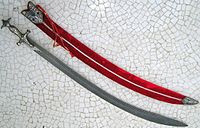

Also known as the talwaar and tulwar, the talwar a traditional Indian sword with a curved blade. It's often compared to the English sabre, which also features a curved blade of similar length. The talwar, however, has been refined over the years, paying a key role in ancient warfare.
Origins of the Talwar
Like other curved swords, including the Persian shamshir and Turkish kilij, the talwar originated from Turkic Central Asia. It's unknown exactly when the first talwar was produced, though historians believe it likely occurred sometime around 1300.
Central Asia was one of the world's leading producers of swords during this era, often exporting or sharing its technology to neighboring countries. This resulted in India, Pakistan and several other countries producing the talwar.
How the Talwar Was Used
One of the reasons the talwar was such a popular and widely used weapon is because it was versatile. Its moderate length allowed warriors to easily wield and maneuver it. Whether they were walking or riding on horseback, warriors could carry the talwar without feeling overburdened.
Additionally, the talwar's design allowed for a more secure grip. The actual handle (hilt) was relatively small compared to other swords. As such, performing a traditional cut -- like that of a sabre -- felt unnatural. This design, however, allowed for a more secure grip when holding the talwar and using it for slicing.
Talwar Construction and Characteristics
Talwar comes from the Sanskrit word "taravari," meaning "one-edged sword." That, of course, is one of the sword's defining characteristics. Rather than featuring a sharp blade on both sides, the talwar was only sharp on a single side: the side that curved out rather than in (see photo above). This feature allowed for a stronger and more formidable weapon. Curved-bladed swords had a tendency to break when both edges were sharpened. Furthermore, only one side of the blade was really used in combat. Therefore, swordsmiths found the tulwar's one-edge blade was a more effective design.
As previously mentioned, the talwar's construction has changed over the years. One of the most notable changes involves a wider blade towards the tip. The talwar would be thin around the hilt and wide around the top. This allowed for more momentum and power when performing slashing attacks.
The talwar was typically forged out of crystalline wootz steel -- the same metal used to make Damascus steel. To produce wootz steel, swordsmiths would add carbon-containing biomass like wood and leaves, along with microalloying materials, to the furnace. As the iron mixed with these materials, it creates a special type of high-carbon steel used to make the talwar that's now known as wootz steel.

Toyotomi Hideyoshi's 1588 order to collect farmers' weapons: what the edict said, how it was carried out, and why historians see it as a change of status more than disarmament.

Where handle rattles come from, how to check safely, when a mekugi needs replacing, and when to stop using the sword.

Around 170 Viking-age blades bear the name Ulfberht. Microscope studies show some were made of crucible steel and many were copies. Here is what we know.


