
Your Cart is Empty


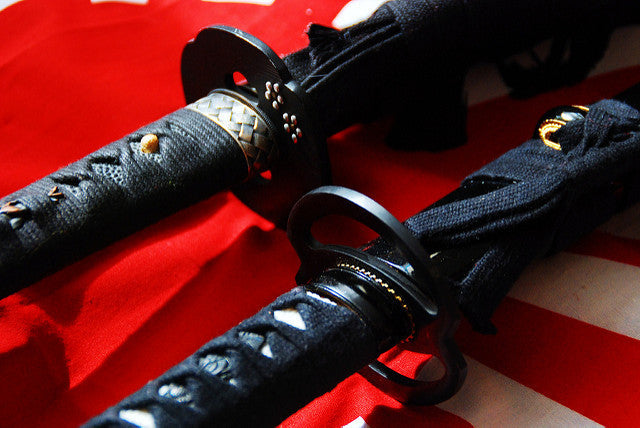

When most people think of weapons wielded by samurai warriors in feudal Japan, they immediately envision the katana. With its distinct curved blade and composition of high-carbon steel, the katana proved instrumental in pre-modern warfare. But there was another weapon wielded and used by samurai warriors in Japan: the wakizashi.
What is the Wakizashi?
The wakizashi, which translates to "side inserted sword," is a traditional Japanese sword worn by samurai warriors. It's similar to the katana in terms of design and construction. While blade lengths vary, most wakizashi blades are between 12 and 24 inches (30 to 60 cm). In comparison, the katana features a blade length of 23 5⁄8– 28 3⁄4 inches (60 to 73 cm), making the wakizashi slightly shorter than its counterpart.
Like the katana, the wakizashi also featured a curved blade. Samurai warriors found curved-bladed swords to be stronger and more effective than straight-bladed swords.
History of the Wakizashi
The wakizashi has a long, rich history dating back to 15th-16th century Japan. Japanese swordsmiths produced it using the same techniques as the katana, including the use of differential heat treatment, multiple blade foldings, and high-carbon steel.
But unlike the katana, the wakizashi was typically used as a backup sword. If the samurai warrior broke or lost his katana, he would unsheathe his wakizashi. Additionally, the wakizashi proved useful for indoor combat -- and that's where its true strength lies.
According to author and researcher of Japanese martial arts Kanzan Satō, the wakizashi became the unofficial successor to the tanto because of its effectiveness when used indoors. The tanto was a smaller, shorter sword that samurai warriors used for indoor combat. With the advent of the wakizashi, however, samurai warriors began to favor the new sword over the traditional tanto.
Eventually, the wakizashi became a standard weapon worn by nearly every samurai warrior in feudal Japan. Samurai warriors would carry the katana as their primary weapon and the wakizashi as their secondary or backup weapon. This format of personal weaponry became so popular that it was even given its own name: daisho.
However, while only samurai warriors could carry the katana, the wakizashi could be worn by members of the chonin class, including merchants. Merchants often required some form of personal protection to fend off bandits when traveling, so they used the wakizashi. But only members of the samurai class could carry the katana.
Photo credit: David Sanz

Toyotomi Hideyoshi's 1588 order to collect farmers' weapons: what the edict said, how it was carried out, and why historians see it as a change of status more than disarmament.

Where handle rattles come from, how to check safely, when a mekugi needs replacing, and when to stop using the sword.

Around 170 Viking-age blades bear the name Ulfberht. Microscope studies show some were made of crucible steel and many were copies. Here is what we know.


