
Your Cart is Empty


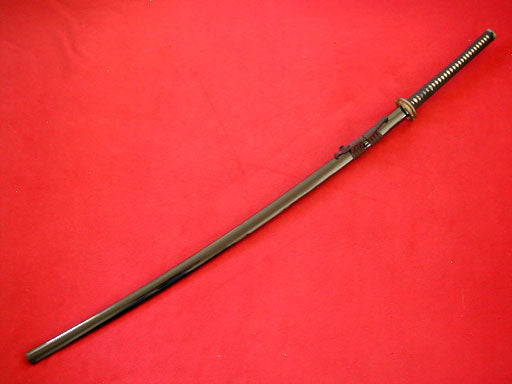

The ōdachi, also known as the nodachi, was a traditional Japanese sword carried and used by samurai warriors during the country's feudal period. Meaning "big sword" or "great sword," it lives up to its namesake by featuring an average blade length of approximately 35.79 inches (90.91 cm). To learn more about the ōdachi, including its rise to fame and subsequent fall from grace, keep reading.
It's unknown exactly when the ōdachi was invented. However, historians believe that Japanese swordsmiths designed it after similar large-bladed swords in China.
Construction and Design
Constructing the ōdachi required a different approach than other traditional Japanese swords. The tachi and katana, for instance, used differential heat treatment processes to achieve a curved, strong blade. By applying a thin coat of clay to the edge and thick coat to the spine, swordsmiths could control the rate at which the sword cooled; thus, resulting in unique properties. The end result was a sword with a flexible spine and hard edge.
The ōdachi, however, was particularly long, making differential heat treatment difficult at best. Furthermore, its large size required a bigger quenching medium to prevent the blade from warping. Many swordsmiths lacked the necessary quenching medium to handle swords of this size.
Even polishing the ōdachi was difficult due to the large size. According to Wikipedia, the ōdachi was suspended from the ceiling or otherwise hung from a tall structure. This is in stark contrast to other swords like the katana, which were generally polished by running the blade over a polishing stone or stones.
Popularity
The ōdachi became popular for a few unique reasons, one of which was its size. With such a massive, long blade, samurai warriors could use the ōdachi to keep their opponents at a safe distance. Granted, the ōdachi's large size made it difficult to carry, with some samurai warriors hiring apprentices to carry it on their behalf.
In addition to its use on the battlefield, the ōdachi was also used for ceremonial purposes. Samurai warriors would use the ōdachi to pray to their gods before battle, and they would also use them as offering at shrines and temples.
Decline
The ōdachi's popularity began to fade in the early 1600s following the Siege of Osaka. During this time, the Shogun government enacted new laws prohibiting the possession of long swords. This prompted swordsmiths to revert back to making shorter swords while subsequently leading to the decline of the ōdachi.
Even as the ōdachi began to fade from popularity, though, it was still used for various ceremonies, including offering to Shinto shrines.

Who the Muramasa smiths really were, how their blades became linked to the Tokugawa family's misfortunes, and why historians treat the curse as legend.

What nagasa, sori, motohaba, kasane, tsuka length, weight and balance point mean, how each is measured, and how to compare two swords fairly.

What the habaki, tsuba, tsuka, menuki, fuchi, kashira and saya actually do, and how to choose each one when you design a custom katana. Illustrated with museum pieces from the Metropolitan Museum of Art.


