
Your Cart is Empty


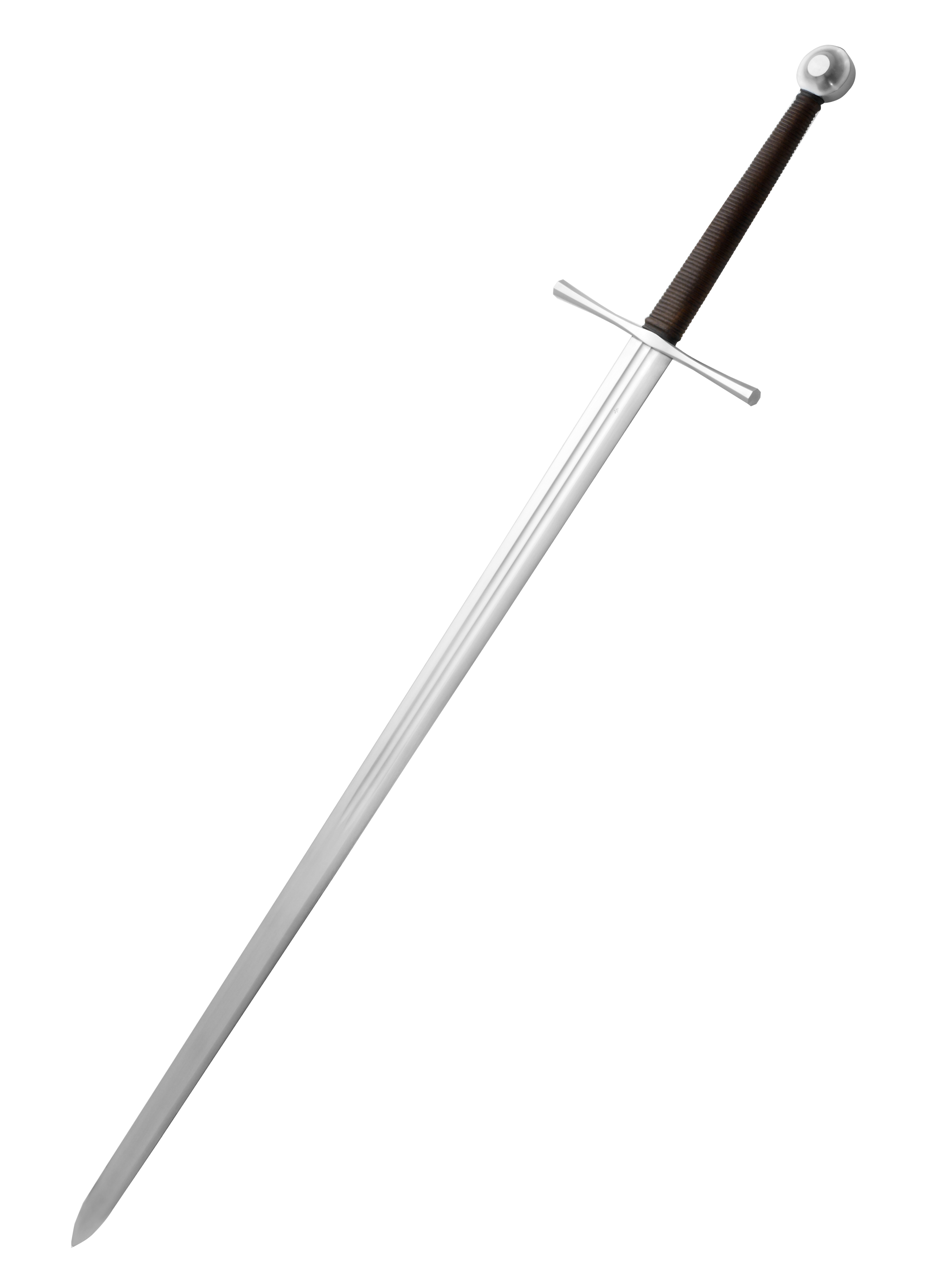

The term "hand-and-a-half sword" is relatively new, first appearing during the 19th century. However, hand-and-a-half swords have actually been around for much longer. So, what is a hand-and-a-half sword exactly?
Overview of Hand-and-a-Half Swords
A hand-and-a-half sword is simply a long sword that can be used with one hand or two hands. Originating in Europe during the medieval ages, it was the preferred choice of weapon among many armies and their soldiers.
Most hand-and-a-half swords featured a cruciform hilt (see image above) and had a straight, double-edged blade spanning 33 to 43 inches (85 to 110 cm). In terms of weight, a typical hand-and-a-half sword weighed roughly 2.4 to 4 pounds (1.1 to 1.8 kg). This balance made the hand-and-a-half sword a formidable weapon, as it was light enough to easily maneuver yet still heavy enough to inflict serious damage when wielded by a skilled swordsman.
Advantages of Hand-and-a-Half Swords
There were several key advantages to using a hand-and-a-half sword. First, they could be easily unsheathed and drawn, allowing the warrior to engage enemies more quickly than using a two-handed sword. Second, hand-and-a-half were more versatile due to their inherit design. Warriors could hold the sword with one hand and hold a shield with the other. Or if the situation presented itself, they could hold the sword with two hands for additional stopping power.
Disadvantageous of Hand-and-a-Half Swords
On the other hand, there were some drawbacks to using hand-and-a-half swords, such as their straight-edged blade. Unlike traditional Japanese swords like the katana and wakizashi, hand-and-a-half swords had a straight blade. This reduced their efficiency as a slashing weapon.
It's also worth mentioning that most hand-and-a-half swords lacked the quality found in traditional Japanese swords. Japanese swordsmiths perfected the art of crafting high-quality swords by using tamahagane steel -- contains a higher content of carbon -- and differential heat treatment. European swordsmiths didn't use these processes, resulting in lower quality swords.
Great Swords
Of course, not all swords featured the same one- or two-hand design as the hand-and-a-half sword. Great swords, for instance, were designed specifically for use with two hands. Originating during the Middle Ages and Renaissance, great swords were often the same length as the height of the user who wielded them. This made them too large and heavy to be held with just one hand. Therefore, warriors held them with two hands.

Toyotomi Hideyoshi's 1588 order to collect farmers' weapons: what the edict said, how it was carried out, and why historians see it as a change of status more than disarmament.

Where handle rattles come from, how to check safely, when a mekugi needs replacing, and when to stop using the sword.

Around 170 Viking-age blades bear the name Ulfberht. Microscope studies show some were made of crucible steel and many were copies. Here is what we know.


