
Your Cart is Empty


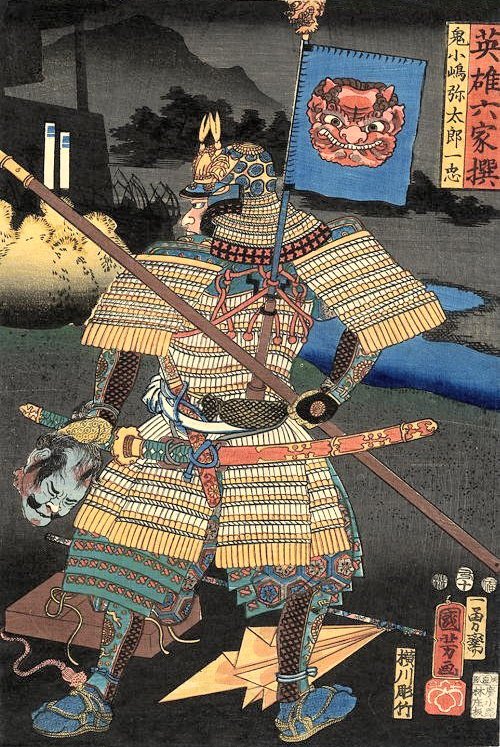

Samurai warriors in feudal Japan carried a variety of weapons and equipment. Rather than carrying just a single sword, for instance, they often carried two swords, such as a katana and wakizashi. With its longer blade, the katana was the samurai warrior's primary weapon, though the wakizashi's shorter blade proved useful as a backup weapon. However, some samurai warriors in feudal Japan also carried small banners known as sashimono.
Overview of the Sashimono
As shown to the left, the sashimono is a small banner worn by samurai warriors during feudal Japan. Like other war banners, it's primary purpose was to help Japanese armies distinguish between companions and opponents during battle.
Sashimono were most popular during Japan's Sengoku period (1467 to 1603), during which the region experienced a great deal of social and political unrest. Because of this chaotic environment, it wasn't uncommon for Japanese clans to battle each other; thus, creating a need for proper identification on the battlefield -- a need that was fulfilled through the use of the sashimono.
Normally, the sashimono was secured to the back of the samurai warrior's armor. Samurai warriors were often equipped with a full set of body armor. The chest armor, known as dou, was comprised of either bamboo or leather plates. On the back side of the dou was a wrapping through which the sashimono secured.
According to Wikipedia, sashimono were worn by all ranks of soldiers in the Japanese army. This includes common foot soldiers ( ashigaru), as well as the elite samurai warriors and even cavalry warriors.
Sashimono Design
Sashimono were made in a variety of designs, the most common of which featured either a black or white design in a rectangular shape. Most sashimono were relatively small, though some variations were designed quite large. In fact, Japanese commanders often carried a particularly large variation of the sashimono known as the uma-jirushi.
So, what exactly did a sashimono feature in its design? Normally, this banner contained just a few basic pieces of information, including the respective clan's name, leader and slogan. The background color varied depending on the army unit. With that said, it wasn't uncommon for some of the elite samurai warriors to carry their own personal sashimono featuring a completely unique design.
To recap, sashimono is a banner worn by Japanese samurai warriors and other soldiers in feudal Japan. It's primary purpose was to help soldiers identify their companions on the battlefield.

Toyotomi Hideyoshi's 1588 order to collect farmers' weapons: what the edict said, how it was carried out, and why historians see it as a change of status more than disarmament.

Where handle rattles come from, how to check safely, when a mekugi needs replacing, and when to stop using the sword.

Around 170 Viking-age blades bear the name Ulfberht. Microscope studies show some were made of crucible steel and many were copies. Here is what we know.


