
Your Cart is Empty


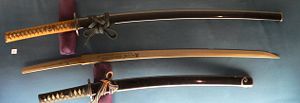

The katate-uchi is a traditional Japanese sword with characteristics similar to that of a katana. It has a curved blade with the same mountings used in the katana. However, there are a few nuances separating the katate-uchi from the katana. To learn more about this traditional Japanese sword, keep reading.
Overview of the Katate-uchi
Originally developed in the late 16th century, the katate-uchi came shortly after the development of the katana. The katana was invented in the early Muromachi period (1336 to 1573), whereas the katate-uchi was invented in the late 1500s. Because of this, Japanese swordsmiths used many of the same materials and craftsmanship.
But while the katana was designed for use with two hands, the katate-uchi was intended for one hand use. This was presumably because of the sword's thin kasane and short tang, which made it particularly lightweight. Nonetheless, the katate-uchi still boasted a relatively long blade measuring up to 27 inches long.
Because it was intended for one hand use, the katate-uchi was often wielded with either another weapon or a shield. Wielding the katate-uchi with a shield allowed for a higher level of defense. With that said, however, shields weren't particularly popular or widely used in feudal Japan. Most samurai warriors preferred to carry and use two swords instead of a sword and shield.
The katate-uchi is often described as being a precursor to the wakizashi. Developed in the late 16th century to early 17th century, the wakizashi was a popular sword used by samurai warriors in feudal japan. Without the katate-uchi, however, perhaps it would have never been invented.
Similarities to the Katana
The katate-uchi and katana were both forged using differential heat treatment. As the name suggests, this involves heating and cooling different parts of the blade at different rates. The spine, for instance, was coated with a thick layer of clay so it cooled more than slowly than the edge. This allowed for a strong edge while creating a somewhat flexible spine.
Additionally, both the katate-uchi and the katana were worn with the cutting edge facing up in the scabbard. Traditional Japanese swords were normally worn with the cutting edge facing down. The katate-uchi and katana, however, were worn with the cutting edge facing up; thus, allowing for a quicker and more efficient drawing technique.
The katate-uchi was also forged with the same high-carbon steel as the katana. Because of its striking similarities, the two swords were often confused with one another.

Who the Muramasa smiths really were, how their blades became linked to the Tokugawa family's misfortunes, and why historians treat the curse as legend.

What nagasa, sori, motohaba, kasane, tsuka length, weight and balance point mean, how each is measured, and how to compare two swords fairly.

What the habaki, tsuba, tsuka, menuki, fuchi, kashira and saya actually do, and how to choose each one when you design a custom katana. Illustrated with museum pieces from the Metropolitan Museum of Art.


