
Your Cart is Empty


Every sword art has a set of manners for handling the sword, usually called reiho or saho, meaning etiquette or the proper way of doing things. Some of it expresses respect for the dojo, the teacher and the sword. Much of it is simple safety: habits that keep the edge away from other people and make an accidental draw unlikely. Schools differ, sometimes a lot, so treat what follows as a general guide and always follow the way your own dojo does things.
Where specific details are given below, they come from the standard iaido forms of the All Japan Kendo Federation ( Zen Nippon Kendo Renmei, often shortened to ZNKR), which are widely practised and publicly documented. Classical schools and other organizations have their own versions.
Practitioners typically bow on entering and leaving the dojo, to the front of the hall ( shomen or shinza), to the teacher, to each other, and to the sword itself.
In the ZNKR standing bow to the front, the sword is moved from the left hand to the right hand, held with the edge facing down and the handle pointing behind you, and you bow by leaning forward about 30 degrees. The bow to the sword ( to rei) is done kneeling: the sword is laid on the floor in front of you and you bow with both hands on the floor. At the start of practice the handle lies to your right; at the end it lies to your left. When bowing to a teacher or senior, the manual asks you to lower your head before they do and rise after they do.

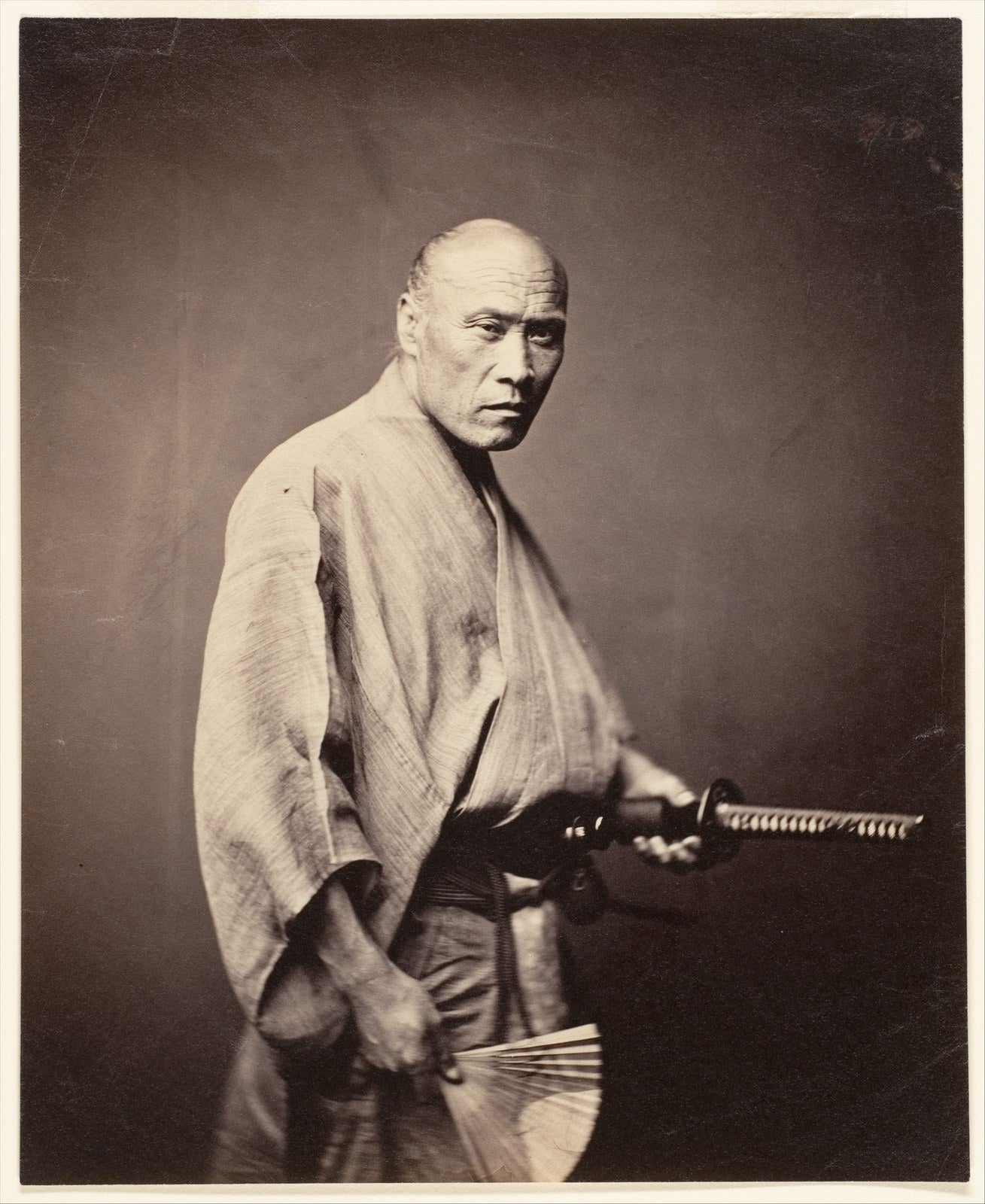
Samurai, Yokohama, 1864 to 1865. Photograph by Felice Beato. The Metropolitan Museum of Art, public domain.
When you are not wearing the sword in your belt, you carry it in the left hand, edge up. In the ZNKR forms there are two named positions:
Wearing the sword in the belt is called taito. You insert it only after the opening bow, and remove it before the closing one.

The actor Ichikawa Omezo as a samurai wearing two swords in his sash. Woodblock print by Katsukawa Shunko. The Metropolitan Museum of Art, public domain.
Passing a sword is where good manners and safety overlap most clearly. The widely taught method, used in formal sword viewing, is:
Passing a sword with the edge toward the other person is considered bad manners. Never hand over a bare blade casually, and never take someone else's sword or draw it without being invited. If you are allowed to look at a blade, do not touch the polished steel: the salts in your skin can leave fingerprints etched into the surface.
Where the sword goes when you sit depends on your art. In the ZNKR forms, when you kneel to bow in a formal hall such as a shrine, the sword is placed on your right, about a fist away from your thigh, parallel to it, with the edge facing in toward you and the guard level with your knee. Bokuto used in kendo kata are also placed on the right with the edge facing in, which is usually explained as a non-threatening position, since the sword cannot be drawn quickly from there.
Kendo practitioners, on the other hand, place the shinai on their left when sitting in almost every club. Neither is wrong. They are different conventions, and your dojo will tell you which it follows.
Wherever you put it, place the sword down quietly. Do not drop it, lean it against a wall where it can slide and fall, or leave it where someone could trip on it.
Etiquette is learned by doing, not by reading. On your first visits to a dojo, watch how the senior students bow, carry and place their swords, and ask your teacher when you are unsure. A qualified instructor will correct small details, and those details often exist for a safety reason you will only appreciate later. Practise the bows and carrying positions slowly until they feel natural, so they do not distract you when you are nervous at a grading or demonstration.
If you are new to the sword arts, our introductions to iaido and kendo are a good place to start. When you are ready for a practice sword of your own, have a look at our training swords, and check with your teacher first about what your dojo expects you to use.

Who the Muramasa smiths really were, how their blades became linked to the Tokugawa family's misfortunes, and why historians treat the curse as legend.

What nagasa, sori, motohaba, kasane, tsuka length, weight and balance point mean, how each is measured, and how to compare two swords fairly.

What the habaki, tsuba, tsuka, menuki, fuchi, kashira and saya actually do, and how to choose each one when you design a custom katana. Illustrated with museum pieces from the Metropolitan Museum of Art.


