
Your Cart is Empty


Every sword listing comes with a short column of numbers: blade length, curvature, width, thickness, handle length and weight. They look precise, and they are, but only once you know what was measured and how. Two swords with almost identical figures can feel quite different in the hand, and two listings can describe the same blade with different numbers. Here is how to read each line, what it changes when you hold the sword, and how to compare two swords fairly.

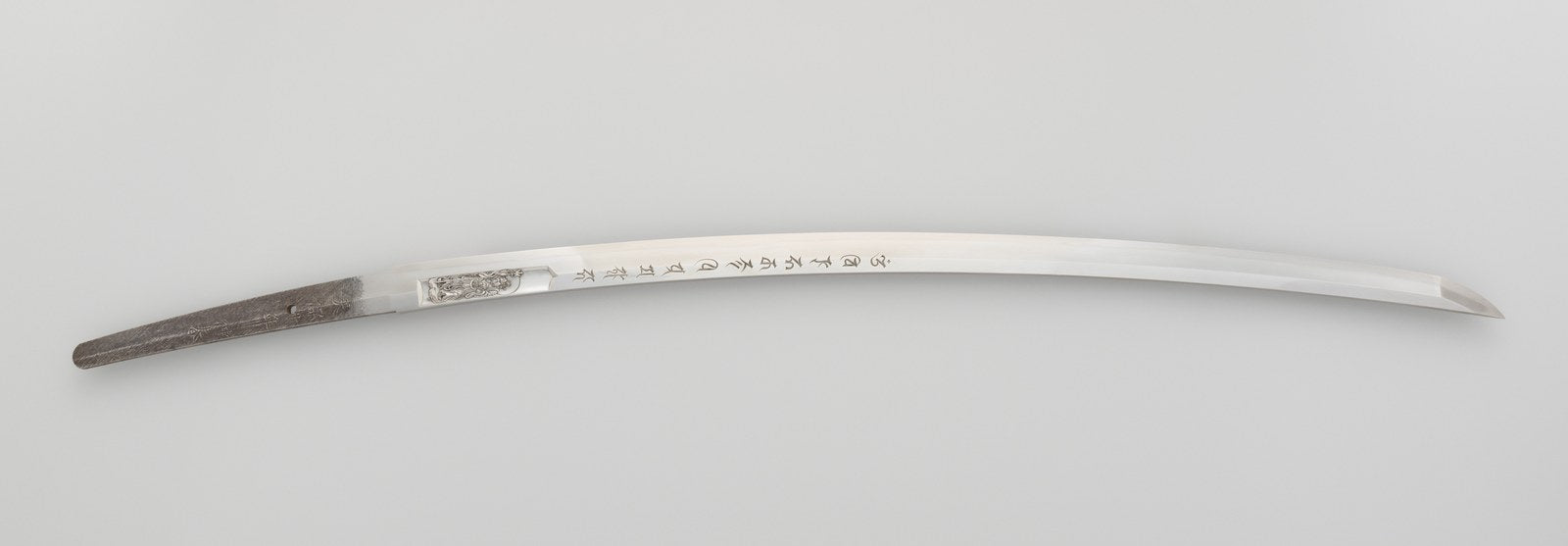
A katana blade by Naotane Taikei, dated 1839. The museum lists its cutting edge at 72.7 cm and its curvature at 3 cm. The Metropolitan Museum of Art, public domain.
The traditional blade length, nagasa, is measured in a straight line from the tip ( kissaki) to the munemachi, the small notch on the back of the blade where the blade ends and the tang begins. Measured this way, the length does not include the tang or the collar ( habaki) that sits over the base of the blade.
Japanese sources give the figure in shaku and sun. One shaku is about 30.3 cm and is divided into 10 sun of about 3.03 cm each, so a blade of 2.40 shaku is about 72.7 cm long.
Not every seller follows the traditional method. Some measure from the tip to the guard, which adds the length of the habaki. We do this ourselves: our blade lengths are measured from the tip to the tsuba, so they include the habaki. Museums use yet another figure, often the length of the cutting edge. None of these is wrong, but a sword measured one way will read a few centimetres differently from the same sword measured another way.
In the hand, a longer blade gives more reach and puts more weight further from your hands. It also asks more of your drawing and sheathing, because there is more blade to clear the scabbard.
Sori is the curvature of the blade. It is measured as the greatest distance between the back of the blade ( mune) and the same straight line used for the nagasa. For comparison, the sori on our own katana is approximately 0.8 inches (about 2 cm) on a 28-inch blade.
The depth is only half the story. Where the curve is deepest also shapes the sword. Koshi-zori has its deepest point toward the handle, torii-zori near the middle of the blade, and saki-zori toward the tip. Spec sheets rarely say which, so look at a side-on photograph of the bare blade. For a practice sword, sori is seldom the deciding number unless your school or teacher asks for something specific.
Motohaba is the width of the blade from edge to back at its base. Sakihaba is the width near the tip, at the yokote line where the point begins. Kasane is the thickness across the back of the blade: motokasane at the base and sakikasane near the tip.
More width and thickness mean more steel, which makes a blade stiffer and heavier. The taper matters as much as the base figures. A blade that stays wide and thick toward the tip carries more of its weight forward, while one that narrows and thins noticeably will feel lighter at the point even if the base measurements are similar.
A groove along the side of the blade ( bo-hi) removes steel and lightens it. As an example of how thickness is used on a spec sheet, our competition geometry katana are 5.5 mm thick and our traditional geometry blades 6 mm, both measured at the habaki end.
The handle ( tsuka) needs room for both hands with a gap between them. A longer tsuka spreads the hands further apart, which gives more leverage, and it moves a little of the sword's weight back toward you. Sizing charts relate it to the size of the practitioner. One iaito retailer's chart, for example, suggests 8.5 to 9 sun (about 26 to 27 cm) for men roughly 170 to 180 cm tall.

A Kuroyuri katana from our Japanese sword collection, listed at a 73 cm blade, a 29 cm handle and 1,100 g.
For weight, check whether the figure includes the scabbard ( saya). Our Shirayuri katana, for instance, is about 1,100 g mounted and about 1,300 g with its saya, so the same sword can be quoted 200 g apart.
Weight alone does not tell you how a sword moves. The point of balance, usually given as a distance from the guard, tells you where the weight sits. Even so, two swords of the same weight and the same point of balance can feel different, because what you actually feel when you turn a sword is how its mass is spread along the whole length. We explain this in more detail in what a sword's point of balance is and why it matters. If a listing does not give the balance point, ask for it.
First, put both sets of figures into the same units and the same measuring convention. Ask each seller whether the blade length includes the habaki and whether the weight includes the saya. Then compare one number at a time.

A matched long and short sword (daisho), blades 15th century, mountings late 18th century. The Metropolitan Museum of Art, public domain.
Two models from our own catalogue show how this works. The Musashi katana is listed with a 69.5 cm blade, a 28 cm handle and a weight of 2.2 lb (about 1,000 g). The Matsu katana has a 73.7 cm blade, a 30 cm handle and weighs 1,100 g. On paper the Matsu is about 4 cm longer in the blade, 2 cm longer in the handle and roughly 100 g heavier. Each difference is modest on its own, but together they add reach and place more of the sword's weight away from your hands, so the Matsu will feel the larger and more deliberate of the two.
The most useful reference is a sword you already know. If you train with a bokken, an iaito or a dojo mate's sword that feels right, measure it the same way and use it as your baseline. For the terms on any listing, our Japanese sword terminology guide is a handy companion.
If you want to set the numbers yourself, our custom sword builder lets you choose the blade length from 25 to 36 inches and the handle length from 9 to 15 inches, and blade weight can usually be adjusted by up to about 200 g. If you are unsure which figures suit you, send us your measurements and we will help you read them.

What the habaki, tsuba, tsuka, menuki, fuchi, kashira and saya actually do, and how to choose each one when you design a custom katana. Illustrated with museum pieces from the Metropolitan Museum of Art.


