
Your Cart is Empty


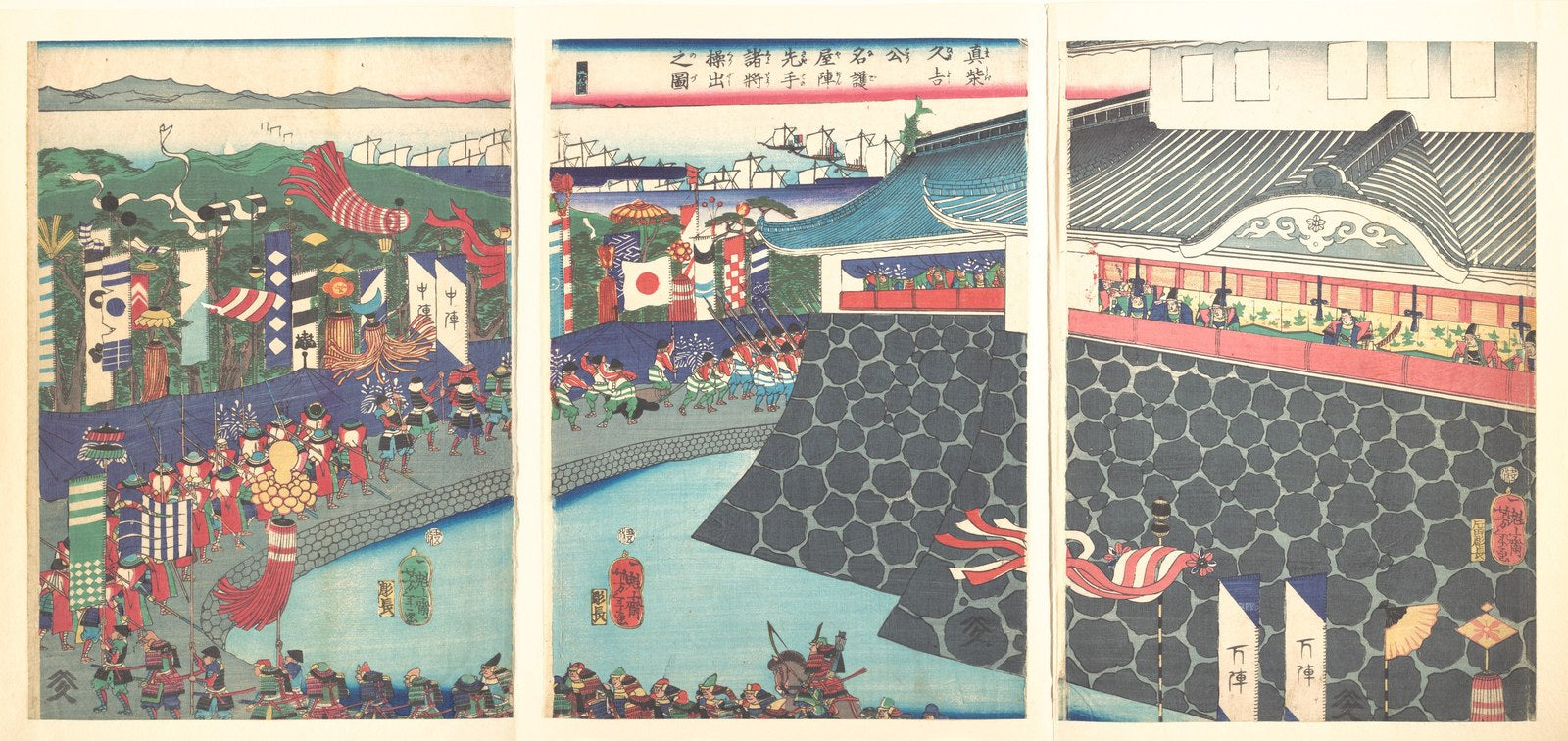
In the summer of 1588, Toyotomi Hideyoshi, the warlord who was then bringing the whole of Japan under his control, ordered that farmers everywhere give up their weapons. The order is known as the katanagari, the "sword hunt". It is often described as the moment Japan's commoners were disarmed and the samurai were made a separate class. The first half of that description is only partly true, and the difference tells you a good deal about what swords meant in Japanese society.

Hideyoshi and his troops leaving the Nagoya camp, a 19th-century triptych by Tsukioka Yoshitoshi. The Metropolitan Museum of Art, public domain.
For more than a century before 1588, Japan had been a patchwork of warring domains. In that world, villages armed themselves for defence, and so did religious institutions. Leagues of Buddhist followers, fortified temples and village alliances fought local lords and sometimes defeated them. Farmers who also fought were the norm, not the exception.
The idea of taking weapons away from them was not new with Hideyoshi. Shibata Katsuie, a general under Oda Nobunaga, carried out a confiscation in Echizen Province, and in 1585 Hideyoshi himself obtained pledges from the monks of Mount Kōya to give up their arms. The 1588 order extended the policy to the whole country.
The edict is dated the eighth day of the seventh month of the sixteenth year of Tenshō, which corresponds to 29 August 1588. It has three short articles, and in the translation published by Columbia University's Asia for Educators programme the main points read as follows:
Not everyone was persuaded by the religious framing. A commentary from the time, printed with the same translation, says plainly that the Buddha was the pretext and the real purpose was to prevent peasant uprisings.
Hideyoshi sent the order to each regional lord separately, under his vermilion seal, and left the collection to the lords, their retainers and their local deputies. Villages were generally held collectively responsible for handing over their weapons, in the same way they were responsible for paying tax.
Few detailed tallies survive. One that does, discussed by the historian Mary Elizabeth Berry, records what was gathered from Enuma county in Kaga Province: 1,073 long swords, 1,540 short swords, 160 spearheads, 500 kōgai (hairpin-like tools carried in a scabbard) and 700 small blades. The Great Buddha hall at the temple of Hōkō-ji was built quickly, but an earthquake destroyed the statue and the hall in 1596. How much of the confiscated metal actually went into it is unclear.
Modern historians, led in Japan by Fujiki Hisashi, argue that the sword hunt did not strip the countryside of weapons. Exemptions allowed arms needed for religious ceremonies and guns used to drive off wild animals, and a great many weapons stayed in villages. What the hunt did change was the right to wear a sword as a mark of who you were. Its main target, on this reading, was status rather than possession.
Hideyoshi followed it in 1591 with the Separation Edict, which forbade samurai and their followers from becoming farmers or merchants and forbade farmers from leaving their fields for trade or wage work. Together with his land surveys, these orders helped fix the line between those who fought and those who farmed.
The line was not drawn all at once. Under the Tokugawa shoguns, townspeople and farmers could still wear swords in many settings until the shogunate restricted it in 1683, and even afterwards the short sword stayed in limited use among commoners. The Meiji government finally ended the wearing of swords in public in 1876, a story we cover in our article on how the end of the samurai era affected Japanese swords.

A matched pair of swords (daishō), the long sword and short sword worn together by samurai. Blades 15th century, mountings late 18th century. The Metropolitan Museum of Art, public domain.
The sword hunt helps explain why the matched pair of long and short swords, the daishō, became the visible badge of samurai status in the Edo period, and why the short sword on its own had a longer life among other classes. When you see a pair of mountings made to match, you are looking at the outcome of a long process of defining who could wear what, of which 1588 was an early and decisive step.
For practitioners, the long and short swords still make a natural pair. Our L6 wakizashi is designed as a companion to a katana for training and competition.

Where handle rattles come from, how to check safely, when a mekugi needs replacing, and when to stop using the sword.

Around 170 Viking-age blades bear the name Ulfberht. Microscope studies show some were made of crucible steel and many were copies. Here is what we know.

The bows, carrying positions and ways of passing and placing a sword taught in many dojo, and why schools differ.


