
Your Cart is Empty


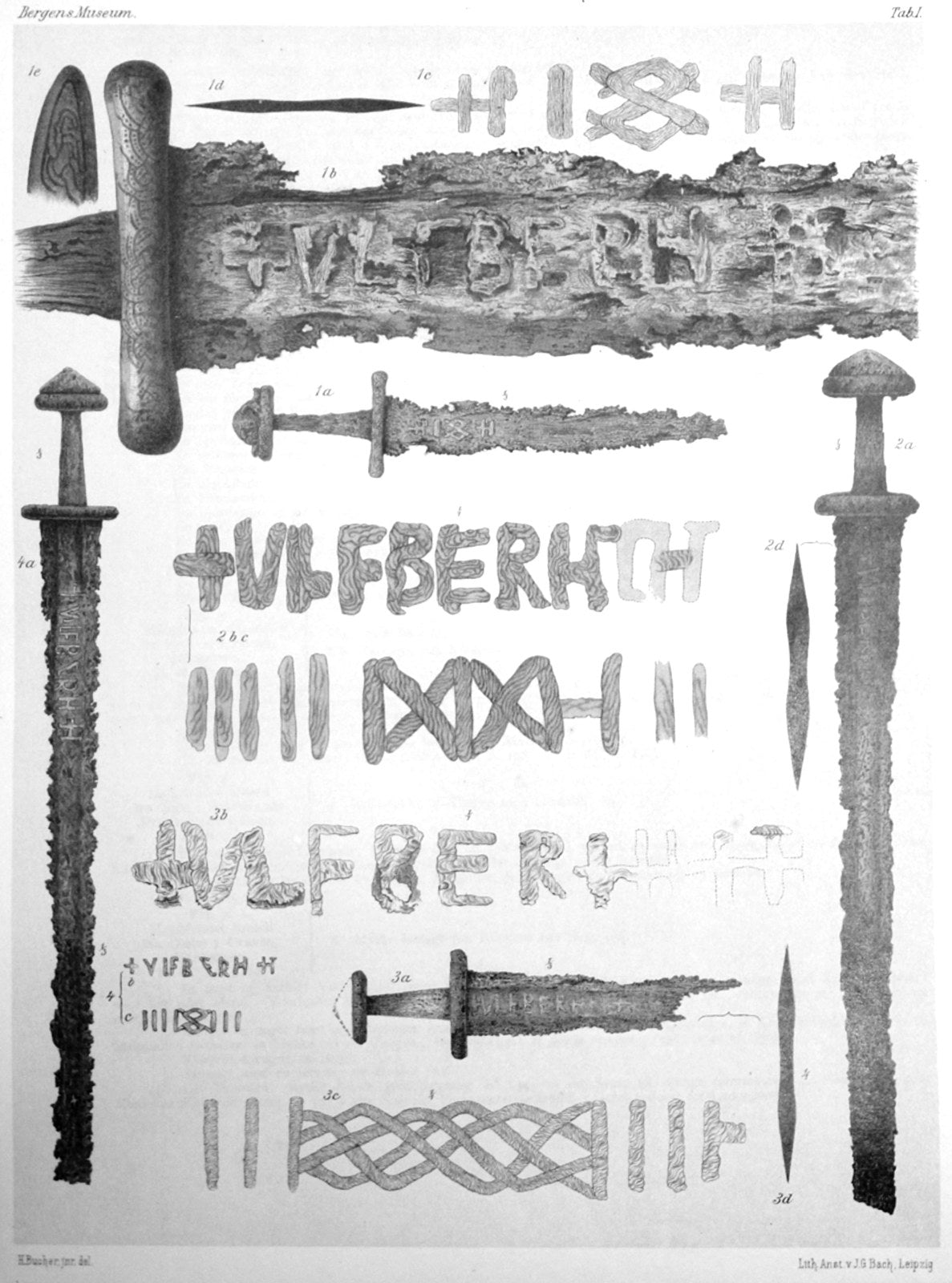
Of all the names found on Viking-age sword blades, one turns up far more often than any other: +VLFBERH+T, usually written today as Ulfberht. Roughly 170 blades carrying the name, or something close to it, have been found across northern and eastern Europe. For more than a century archaeologists have asked who Ulfberht was and why his swords were so widely copied. In recent decades, metallurgy has supplied part of the answer, along with new questions.

Ulfberht blades in the Bergen Museum, drawn for A. L. Lorange's 1889 study of Norwegian Viking swords, showing the inscriptions and the geometric marks on the other face. Via Wikimedia Commons, public domain.
A typical Viking-age sword was a straight, double-edged, one-handed weapon about 90 cm long or a little more, with a short grip and a heavy pommel. The Ulfberht swords follow this pattern. What marks them out is the name inlaid into one face of the blade, usually framed by crosses, with a pattern of lines and lattice on the other face.
Ulfberht is a Frankish name, not a Norse one. Most of the swords have been found in Scandinavia, and Norway has yielded more than any other country, but the historian Ingo Petri points out that this reflects different burial customs: Scandinavians of the period often buried weapons with the dead, while the Christian Franks generally did not. His review concludes that the blades were most probably made in the Frankish Empire and travelled north as loot or ransom. The swords date from roughly the 9th to the 11th century.
Who Ulfberht was is still debated. The archaeologist Anne Stalsberg, who catalogued the known blades in 2008, argued that the name more likely belonged to someone overseeing sword production within a church or monastic setting than to a single smith at the anvil.

A Viking sword, probably Scandinavian, 10th century. The Metropolitan Museum of Art, public domain.
Earlier European swords were usually pattern-welded, built up from twisted bars of iron and steel forged together. The metallurgist Alan Williams, of the Wallace Collection in London, notes that during the Viking period these were steadily replaced by blades made from a few pieces of iron and steel, or even from a single piece of steel. The Ulfberht swords are the best-known of this new generation.
Most European steel of the time came from the bloomery, a furnace that reduces iron ore to a spongy mass without ever melting it. Bloomery steel holds threads of glassy slag, and its carbon content varies from place to place. Crucible steel is made differently: iron and carbon-bearing material are sealed in a clay crucible and heated until the charge melts, giving a steel with high, evenly spread carbon (around 1.2 percent, sometimes more) and very little slag. It is hard and strong, but Williams notes that it has to be forged at a lower temperature than smiths of the time were used to.
In a study published in 2009, Williams cut samples from 44 Ulfberht and related swords and examined them under the microscope, with electron microanalysis on selected pieces. The results split the swords into groups by how the name was spelled.
One blade drawn on Lorange's plate above, Bergen no. 3149, had a body of steel with at least 1 percent carbon. Another sword contained traces of graphite, which Williams linked to a crucible recipe described by the scholar al-Biruni (973 to 1048) that melted soft iron together with cast iron.
Crucible steel was made in Central Asia, Iran and India; there is no evidence it was made in Frankish Europe at the time. Williams proposed that ingots reached the Baltic along the Volga trade route, which Vikings used in the 9th and 10th centuries, and noted that the swords seem to stop when that trade declined. He presented this as the likely explanation, not a proven one.
If the original Ulfberht blades were exceptional, the name was worth faking. Williams interprets the +VLFBERHT+ group as the work of one workshop that copied the name exactly except for the position of the final cross, and the other spellings as copies of varying quality. The Ulfberht name, in other words, behaved like a trademark that other smiths borrowed.
Plenty remains unsettled. Williams placed the maker near the Baltic, where the crucible steel would have arrived; Stalsberg and Petri place production in the Frankish Rhineland. The number of swords tested is small next to the 170 known, and each test means cutting into an archaeological object. Treat confident popular claims, such as the idea that Viking smiths had steel technology centuries ahead of its time, with caution.

A Carolingian sword, 8th century, from the Frankish realm where the Ulfberht blades were probably made. The Metropolitan Museum of Art, public domain.
The Ulfberht story holds some practical lessons for anyone choosing a sword today:
For more on historic high-carbon steels, see our article What is Damascus steel?. If you are comparing modern blades, most of the katanas in our Japanese sword collection are made from L6 steel and differentially heat treated, and each listing states the steel so you know what you are buying.

The bows, carrying positions and ways of passing and placing a sword taught in many dojo, and why schools differ.

Who the Muramasa smiths really were, how their blades became linked to the Tokugawa family's misfortunes, and why historians treat the curse as legend.

What nagasa, sori, motohaba, kasane, tsuka length, weight and balance point mean, how each is measured, and how to compare two swords fairly.


