
Your Cart is Empty


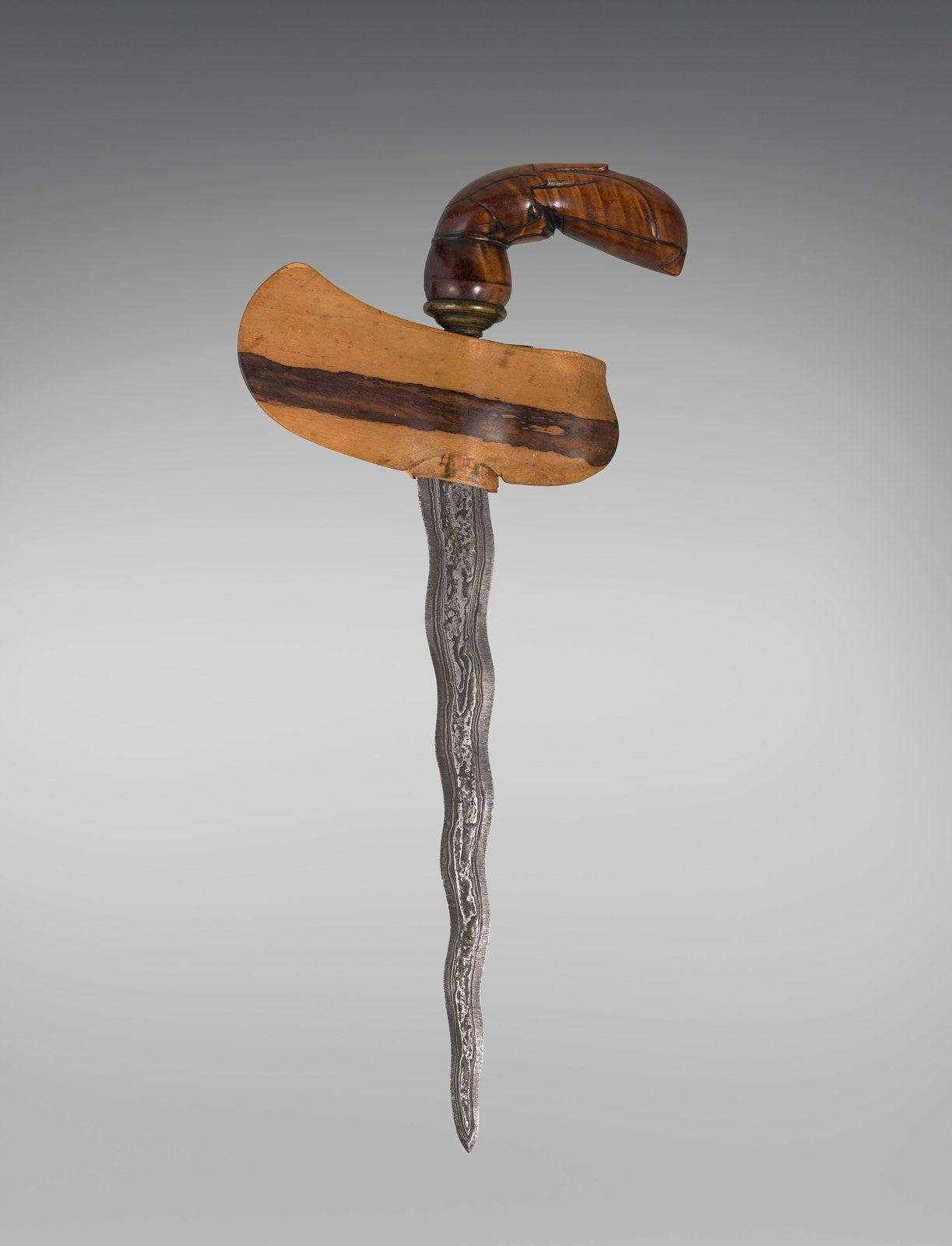
The kris, or keris, is the signature blade of the Malay world. It is found across Indonesia and Malaysia and in parts of Thailand and the Philippines, and it is instantly recognizable: a narrow, asymmetrical dagger, broad at the base, often with a wavy blade. It is also much more than a weapon. For many owners a kris is a family heirloom, a mark of status and an object believed to have a spirit of its own. In 2005 UNESCO proclaimed the Indonesian kris a masterpiece of intangible heritage, and it was inscribed on the Representative List of the Intangible Cultural Heritage of Humanity in 2008.

A Javanese kris with a wavy blade, 1800s. The wide, boat-shaped piece is the top of its wooden sheath. The Cleveland Museum of Art, Gift of J. H. Wade, CC0.
Everyone agrees that the kris took shape on Java, but accounts of when differ. UNESCO's description dates the earliest known kris blades to the 10th century. The Pitt Rivers Museum in Oxford places its origin in 14th-century Java, under the Hindu kingdom of Majapahit, and the Royal Armoury in Stockholm describes it as appearing at the end of Java's Hindu-Buddhist period. From Java it spread through the archipelago and the Malay Peninsula, and each region developed its own forms. Balinese kris, for example, tend to be longer and larger than Javanese ones.
A kris blade is asymmetrical. At its base is the ganja, the guard section at the widest part of the blade. From there the blade may run straight or in a series of curves called luk. Blades are described by their number of luk: a kris in the Horniman Museum in London, for example, is catalogued as a "keris luk with eleven luk." In one common reading, a wavy blade represents a naga, a serpent-dragon, in motion, and a straight blade the naga at rest.
Connoisseurs judge a kris on three things, according to UNESCO: the dhapur, the form and design of the blade, with around 40 recognized variants; the pamor, the pattern in the metal, with around 120; and the tangguh, its age and place of origin. The hilt and the sheath are thought of as the blade's clothing. Hilts were often carved as Hindu figures, and after Islam spread on Java they became more stylized.

A straight-bladed Javanese kris, 1800s, with the layered pamor pattern visible along the blade. The Cleveland Museum of Art, Gift of J. H. Wade, CC0.
Pamor is the kris's equivalent of pattern-welding. The smith layers iron with a nickel-bearing metal, forge-welds the stack and folds it, according to UNESCO "dozens or hundreds of times," then works it so that the layers surface as a pattern. The Pitt Rivers Museum notes that skilled makers could produce patterns resembling wood grain or leopard spots, or the kenanga pattern named after a flower. On a finished blade, the nickel-rich layers show as a pale pattern against darker iron.
Some of the most prized nickel came from space. According to Javanese tradition and several published accounts, an iron meteorite that fell near the Prambanan temples in central Java in the late 18th century was taken to the royal court at Surakarta, and small pieces of it were used for pamor on high-status blades. Accounts give different dates for the fall. Particular pamor patterns were believed to bring their owner popularity, wealth or protection, which is part of why owners chose them with care.
The makers of kris are called empu. UNESCO describes them as highly respected craftsmen whose knowledge reaches beyond metalwork into literature, history and the occult sciences. Empu still work on several Indonesian islands, but UNESCO notes that their numbers are falling and that passing the craft to younger smiths is a real concern.
According to UNESCO, men and women once wore the kris every day as well as on special occasions, and it served as a weapon, a talisman, a status symbol and a sacred heirloom handed down through families. The Pitt Rivers Museum records beliefs that a kris could ward off illness, help in childbirth and bring victory, and that each blade had its own spirit, so a kris in the wrong hands could cause misfortune.
That respect is still visible in ceremony. Every year in Sura, the first month of the Javanese calendar, the Yogyakarta palace holds Jamasan Pusaka, the ritual cleaning of its heirlooms. Metal weapons are washed with lime juice, then treated with warangan, an arsenic-based preparation, and coconut oil. In Malaysia, the royal regalia worn at the installation of the king includes ceremonial keris.

A Balinese kris with an ornate gilded hilt, 1800s. The Cleveland Museum of Art, Gift of Mrs. James W. Corrigan, CC0.
If you want to study kris up close, museum online collections are a good start: the Cleveland Museum of Art, the Pitt Rivers Museum and the Royal Armoury in Stockholm all publish photographs and notes. If you own one, a few precautions apply:
Polished blades such as a katana or jingum need different care. For those, the maintenance supplies in our miscellaneous collection, including sharpening stones and metal polish, are made for the job.

How to choose a sword for someone else: matching it to their art, sizing it without spoiling the surprise, useful extras, and lead times for custom work.

How to size an iaito for your height, weigh alloy against steel, judge the handle and fittings, and what to ask your sensei and the seller first.

Toyotomi Hideyoshi's 1588 order to collect farmers' weapons: what the edict said, how it was carried out, and why historians see it as a change of status more than disarmament.


